
Hot Peel vs. Cold Peel DTF Film: Which Boosts Production Speed?
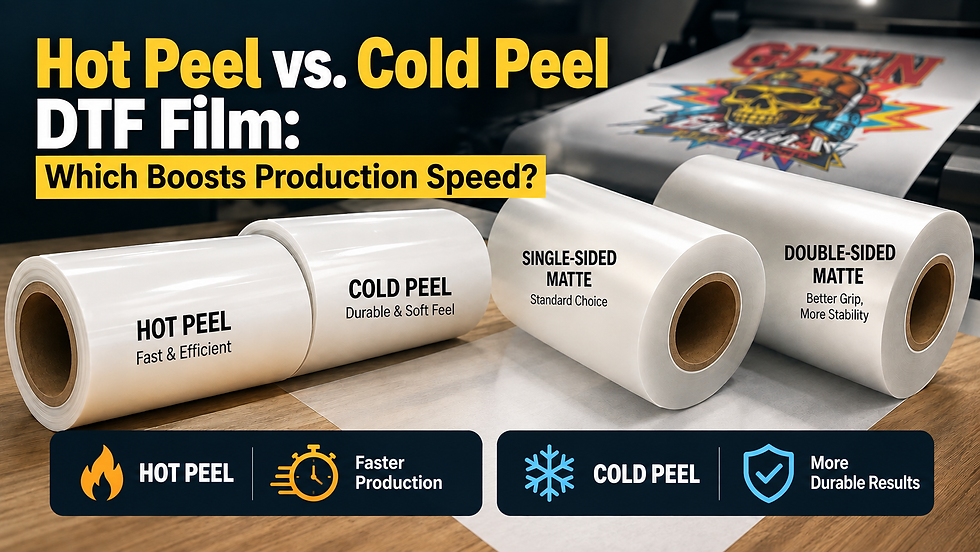
Hot peel DTF film wins on raw production speed because you peel it straight off the press with no cooling wait, while cold peel DTF film trades that speed for sharper detail and more forgiving handling. The real answer depends on two factors together: peel type and film thickness. A 75-micron cold peel film and a 100-micron hot peel film behave nothing alike on your press, even though both fall under the same "DTF film" label.
This guide breaks down hot peel vs. cold peel DTF film in practical, shop-floor terms. You will see how peel timing affects press cycle time, how 75-micron and 100-micron film change feeding and durability, and which combination fits your order volume.
Hot Peel vs. Cold Peel DTF Film: The Core Difference
Hot peel film releases from the garment within 3 to 5 seconds of the heat press opening, while the transfer is still hot. Cold peel film needs 15 to 30 seconds, sometimes longer, to cool before it separates cleanly. That gap sounds small, but multiplied across hundreds of daily presses, it becomes the difference between finishing a run before lunch or after it.
Warm peel sits between the two, needing a short 4 to 6 second cooldown. Many modern films are labeled "instant hot/cold peel," meaning the coating releases at either stage, so you are not locked into one workflow per roll.
Peel Type | Wait Time After Pressing | Best For |
Hot Peel | 0 to 5 seconds | High-volume orders, simple graphics |
Warm Peel | 4 to 6 seconds | Balanced runs, temperature-sensitive presses |
Cold Peel | 15 to 30+ seconds | Fine detail, small text, gradients |
Instant Hot/Cold | Either | Mixed job types on one roll |
How Peel Type Impacts Your Production Workflow Speed
Peel timing directly sets your press cycle time, and press cycle time sets your daily output ceiling. If your press cycle runs 12 seconds to apply and 4 seconds to peel hot, you finish a transfer roughly every 16 seconds. Swap in a cold peel film needing 25 seconds of cooling, and that same transfer now takes closer to 37 seconds. Over an 8-hour shift, that gap can mean hundreds fewer transfers.
Shops running bulk apparel orders, event merchandise, or same-day rush jobs generally default to hot peel film. Alpha Print Supply's 12" Ultra Premium Double Matte Hot Peel film is built for exactly this scenario.
Detail-heavy work changes the calculation. Fine linework, small text, and gradient shading are more prone to cracking if you peel too soon. Cold peel gives the adhesive layer time to fully set, protecting sharp edges. Shops mixing both job types often keep a roll of instant hot/cold film on hand to avoid swapping media mid-shift.
75 Micron vs. 100 Micron DTF Film: Thickness and the Speed vs. Detail Trade-off
Thickness is measured in microns and refers mainly to the PET base layer beneath the ink-receiving coating. It affects how the film feeds, how it holds up under mechanical tension, and how much fine detail it reproduces.
75 Micron Film: Detail and Softer Hand Feel
A 75-micron film is thinner and more flexible. It transfers heat more evenly during pressing, preserving hairline text and intricate artwork. Finished transfers also sit softer against the fabric. The trade-off is durability under tension; thin film is more prone to wrinkling or tearing on fast roll-to-roll printers if feed tension is not dialed in correctly.
100 Micron Film: Stability for High-Speed Runs
A 100-micron film is stiffer and runs straighter through high-speed printers and shakers. It resists curling during curing and tolerates minor press temperature swings better than thinner stock, making it a common choice for roll-fed production lines and heavy-use workwear. The slight cost is fine detail precision at very high resolutions, though this rarely shows on standard apparel graphics.
Spec | 75 Micron | 100 Micron |
Feed stability | Requires tight tension control | More forgiving on fast feeds |
Detail reproduction | Excellent for fine lines and text | Good, slightly less precise at high DPI |
Hand feel | Softer | Slightly stiffer |
Best fit | Small runs, detail-critical work | High-volume, roll-fed production |
Which Combination Wins for Speed?
For maximum production workflow speed, pair hot peel with 100-micron film. The thicker base survives fast feed tension, and the instant release keeps your press cycle short, suiting shops running large gang sheets or continuous roll orders.
For detail-critical, lower-volume jobs, cold peel with 75-micron film is the stronger match. You sacrifice some cycle speed but gain sharper output on small text and fine art. The powder you pair with the film also affects the outcome; Alpha Print Supply's DTF Fine Powder is formulated for this kind of detailed, soft-feel work.
How to Choose the Right DTF Film for Your Shop
Match film choice to your actual order mix rather than a single "best" spec:
High daily volume, simple graphics: hot peel, 100 micron
Boutique or custom orders with fine detail: cold peel, 75 micron
Mixed job types: instant hot/cold, either thickness
New to DTF or unsure of your press timing: start with a mid-range roll from Alpha Print Supply's DTF PET film lineup and adjust based on peel results
Faster Floors, Sharper Prints: Your Next Move
Peel type and film thickness are not separate decisions. They work together to define how fast your shop moves and how clean your final print looks. Once you know your order mix, matching the right film becomes straightforward. Alpha Print Supply stocks hot peel film across multiple widths, along with the consumables and equipment that round out a reliable DTF workflow. If you are ready to tighten your production line, reach out to the Alpha Print Supply team and get equipped with film matched to your real output goals.
Frequently Asked Questions
Is hot peel or cold peel DTF film better for beginners?
Hot peel is generally easier for beginners since the shorter wait time means fewer chances for handling errors. Cold peel requires more patience and consistent timing. Many new shops start with an instant hot/cold film to learn both techniques on one roll.
Does DTF film thickness affect wash durability?
Thickness has a smaller effect on wash durability than powder and ink quality. Thicker 100-micron film can produce more consistent adhesive coverage on large designs, which indirectly supports longer-lasting prints. Proper curing and pressing temperatures still matter more.
Can I use 75-micron and 100-micron film on the same printer?
Yes, most DTF printers handle both thicknesses, though you may need to adjust feed tension settings. Test a short run before committing to a full roll on a new thickness. Check your printer's manual for its recommended micron range.
Why does my hot peel film sometimes stick during peeling?
Sticking usually points to insufficient press temperature, pressure, or dwell time rather than a film defect. It can also happen if the film absorbed humidity during storage. Store rolls in a cool, dry space and verify settings against manufacturer recommendations.
What is the fastest DTF film setup for high-volume orders? A 100-micron hot peel film paired with a reliable powder shaker and a consistent heat press gives the shortest overall cycle time. This setup minimizes both peel wait time and feed-related slowdowns, and it is what most high-output shops rely on for daily bulk production.


Comments