
Screen Printing Plus DTF: When Does a Hybrid Model Make Sense?

Quick answer: A hybrid screen printing and DTF shop makes sense once you're regularly turning away orders under 24–50 pieces, quoting full-color designs that would need 5+ screens, or juggling rush jobs screen printing can't turn around fast enough. Running both methods lets you route each order to whichever process is cheaper and faster, instead of forcing every job through one workflow.
This guide breaks down exactly where that break-even point falls, where screen printing still wins outright, and what equipment you need to add DTF printing to an existing shop.
What Is a Hybrid Screen Printing and DTF Shop?
A hybrid shop runs both screen printing and direct-to-film (DTF) printing, sending each order to whichever method costs less and finishes faster. You keep your screens and presses for bulk work, and add a DTF printer or DTF transfers for jobs screen printing can't handle profitably.
This isn't a trend it's a routing decision. Many decorators already run both, using DTF for one-offs and rush orders, and screen printing for planned runs of 100 or more identical pieces.
Screen Printing vs. DTF: Quick Comparison
Factor | Screen Printing | DTF Printing |
Best order size | 150–500+ pieces | 1–100 pieces |
Setup cost per design | $25–$35 per screen/color | None |
Color limit | Each color = a new screen | Unlimited colors, one transfer |
Typical turnaround | 5–7 business days | Often same-day |
Cost at high volume | $3–$7 per piece | Higher than screen printing per piece |
Cost at low volume | High (setup fees dominate) | Flat, no setup penalty |
Wash durability | Excellent (plastisol) | ~100 wash cycles with quality powder |
When Does a Hybrid Model Make Sense?
1. You're Turning Away Small Orders
If you decline orders under 24 pieces because screen fees make them unprofitable, you're leaving money on the table. A one-color job typically carries a $25 to $35 setup fee per screen. On a 12-piece order, that cost alone can run $2 to $3 per shirt before you've bought the blank. DTF has no screen fee, so a 5-piece order costs the same per print as a 50-piece order.
2. Your Order Sizes Swing Wildly
Shops that print for sports leagues, schools, and local businesses rarely get consistent order sizes. One week it's 200 identical jerseys. The next it's 8 shirts with 8 different names. Hybrid production lets you screen print the bulk run and use DTF for the small, personalized batch without quoting two vendors.
3. You Want Full-Color Designs Without Extra Screens
Every color in a screen printed design needs its own screen. A 3-color logo needs 3 screens. A 7-color, photorealistic design needs 7 or more, plus tighter registration. DTF printing prints unlimited colors and photo-quality artwork as a single transfer, at the same cost as a one-color job. If customers ask for detailed artwork on small runs, DTF removes the color penalty entirely.
4. You Need Faster Turnaround on Rush Jobs
Standard screen printing runs 5 to 7 business days after proof approval, since screens must be burned, exposed, and washed out first. DTF skips that step. You print, powder, and cure the film, then press it whenever you're ready, often the same day the order comes in.
The Break-Even Math
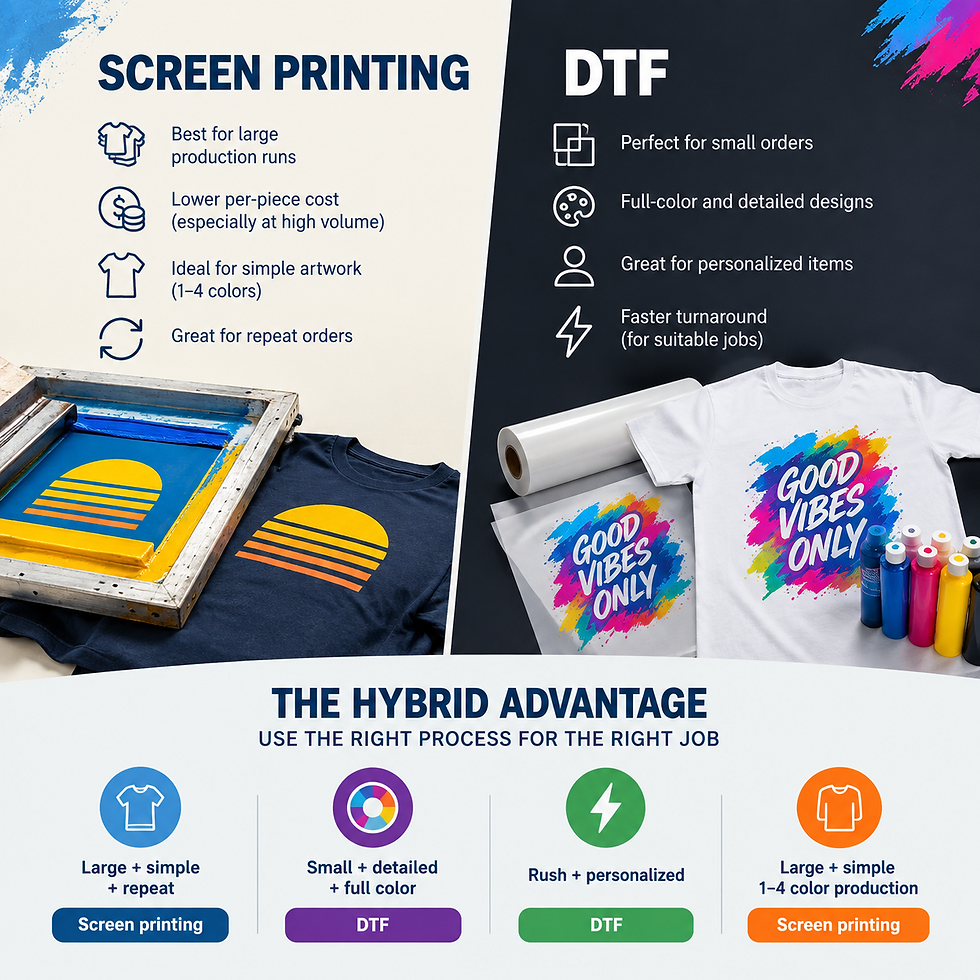
Hybrid doesn't mean DTF replaces screen printing. It means using the right tool for the job size.
Job type | Better method | Why |
1–4 color design, 150+ pieces | Screen printing | Setup cost spreads thin; per-piece cost drops to $3–$7 |
Repeat orders, screens on file | Screen printing | No new setup fee on reorders |
Bold, 1–2 color spot logos | Screen printing | Exactly what the process was built for |
Under 24–100 pieces (varies by color count) | DTF | No setup fee, wins on cost and speed |
Full-color or photo-quality art, any small run | DTF | No per-color penalty |
Break-even between DTF and screen printing generally falls between 24 and 100 pieces, depending on color count and local pricing. Below that range, DTF usually wins on cost and speed. Above it, screen printing's per-piece advantage takes over.
What You Need to Add DTF to a Screen Printing Shop
Adding DTF printing alongside your existing screen printing setup doesn't require replacing anything. Most shops add three core components:
A DTF printer sized to your volume. Lower-volume shops often start with an entry-level all-in-one unit like Rustic United 16.5" All-in-One DTF Printer with Powder Shaker, while higher-volume shops move to a dedicated production printer such as the Mimaki TxF150-75 or the STS Inks XPD-924D that is a combo of DTF printer and powder shaker.
PET film and ink. Adhesion and print quality depend on consistency. Rustic United Ultra Premium Double Matte Hot Peel film and DTF Inks are common starting points.
Powder and a shaker. The 24" STS Automatic S-20 Powder Shaker automates powder application, cutting labor and reducing uneven coverage versus shaking by hand.
Signs a Hybrid Model Isn't Worth It Yet
Hybrid production isn't automatic for every shop. Skip it, for now, if:
Your orders are consistently 200+ pieces of the same simple design.
You lack staff bandwidth for two production workflows and two quoting systems.
Your small-order volume is too low to justify new equipment yet.
Build a Production Model That Matches Your Orders
The businesses that win in custom apparel aren't choosing DTF or screen printing. They're matching the method to the job. Small, complex, or rush orders go to DTF. Large, simple, repeat orders stay on the press. That routing decision can be the difference between turning away business and capturing every order size that comes through your door.
Alpha Print Supply works with print shops adding DTF to their existing operations, from entry-level printers to full production setups. Ready to add DTF to your screen printing business? Explore our complete selection of DTF printers and premium consumables to create consistent, professional-quality transfers.
Frequently Asked Questions
Is it expensive to add DTF to an existing screen printing shop?
Entry-level DTF printers cost well below a full screen printing press setup. Many shops recover that cost within a few months by capturing small orders they previously turned away, and you can outsource transfers first to test demand.
What order size should go to screen printing instead of DTF?
Simple 1 to 4 color designs at 150 pieces or more usually cost less per piece through screen printing. Below that, especially for full-color or one-off designs, DTF is typically cheaper and faster.
Can one operator run both DTF and screen printing in a small shop?
Yes. DTF requires less hands-on labor per print than pulling screens, so many small shops run both with the same staff, given enough space for a printer alongside the existing press and screens.
Does DTF durability hold up as well as screen printing?
Modern DTF transfers with quality adhesive powder can withstand around 100 wash cycles without significant cracking. Screen printing durability depends on ink type, with plastisol holding up well but sitting thicker on the fabric.
How do I decide which jobs go to DTF versus screen printing? Base it on quantity and color count. Small runs, rush orders, and full-color designs go to DTF. Large runs of simple, 1 to 2 color designs go to screen printing. Track a few real jobs to confirm your shop's break-even point.


Comments