
Sublimation Printing as a Business: Honest Profit Potential
- Apr 11
- 6 min read
Updated: Apr 12
It covers home-based and small-scale sublimation businesses targeting the custom apparel and merchandise market. It does NOT address industrial-scale sublimation operations or commercial textile printing at factory volume.
Is sublimation printing a good business?
The honest answer depends entirely on three things most beginner guides never address: your material flexibility, your pricing math, and whether your target market is already flooded. Get those right and sublimation is a legitimate income source. Get them wrong and you've got an expensive hobby.
What Sublimation Printing Actually Is (And Why the Limitation Matters)
Sublimation printing is a heat-transfer process where ink converts to gas and bonds permanently with polymer-coated or polyester-based surfaces. The result is a vibrant, wash-resistant print that becomes part of the material — not a layer sitting on top of it.
Here's the thing: that last sentence contains the most important business caveat nobody talks about.
Because sublimation only bonds with polyester or polymer-coated substrates, cotton is off the table. Completely. And cotton accounts for roughly 60% of the custom apparel market — everything from Gildan tees to most hoodies people actually want to buy.
This isn't a minor technical footnote. It's a structural business constraint.

According to Grand View Research (2024), the global dye sublimation printing market was valued at $14.9 billion and is projected to grow at a CAGR of 11.3% through 2030. That's a real, expanding market. But that growth is concentrated in sportswear, promotional products, and hard goods — not the cotton custom tee market that most beginners picture when they first Google "sublimation business."
Most people assume sublimation competes directly with DTG (direct-to-garment) printing on any fabric. The data says otherwise — they serve genuinely different markets, and conflating them is how beginners end up with equipment that doesn't match what their customers actually want.
Featured Snippet Definition Block:
Sublimation printing is a heat-based printing method where dye bonds permanently with polyester or polymer-coated surfaces. It produces fade-resistant, full-color prints but cannot be used on natural fabrics like cotton or linen.
What It Actually Costs to Start (With Real Numbers, Not Ranges)
Startup costs for sublimation vary wildly depending on who you ask. Here's what a realistic entry-level setup actually looks like in 2026.
Option | Best For | Key Benefit | Limitation |
Sawgrass SG500 + basic heat press | Home beginners, low volume | Low entry cost (~$500–$700 total) | Small format, slow for scaling |
Epson EcoTank converted printer | Budget-conscious starters | Cheap ink per page | Voiding warranty, inconsistent ICC profiles |
Sawgrass SG1000 + 16x20 press | Serious side-hustle operators | Larger format, faster turnaround | ~$1,200–$1,500 upfront |
Condé Systems bundle kits | All-in-one buyers | Curated equipment, training support | Premium price, less flexibility |
Quick Comparison — use this to match equipment to your actual volume goals, not to your startup excitement.
The baseline honest budget: $600–$900 gets you a functional setup. Below that, you're making compromises that hurt print quality. Above $1,500, you're investing at a level that only makes sense if you already have orders.
What most guides don't include in startup costs:
Blanks inventory: $150–$300 to stock polyester shirts, mugs, and tumblers before your first sale
ICC color profiles: Free if you use Sawgrass CreativeStudio, but learning curve is real
Shipping supplies: Easily $50–$100 upfront if you're selling online
Etsy or Shopify fees: $0.20 per listing on Etsy, or $29/month for Shopify — neither is "free"
Quick note: the $300 sublimation setups you see promoted on YouTube are real, but they're almost always EcoTank conversions where someone has voided a warranty and accepted print inconsistency as a tradeoff. Not wrong — just something to know going in.
The Profit Margin Reality: What You Can Actually Make
Let's run a real cost-of-goods breakdown — the kind competitor articles consistently skip.
Example product: Custom sublimation tumbler (20oz)
Cost Item | Amount |
Blank tumbler (bulk, 12-pack) | ~$4.50/unit |
Ink cost per print | ~$0.30–$0.60 |
Transfer paper | ~$0.15 |
Heat press electricity (approx.) | ~$0.05 |
Packaging/mailer | ~$1.00 |
Total COGS | ~$6.00–$6.30 |
Average Etsy selling price for a custom tumbler: $22–$28.
Gross margin before platform fees: roughly 65–72%.
After Etsy's 6.5% transaction fee, listing fee, and payment processing: closer to 55–62% gross.
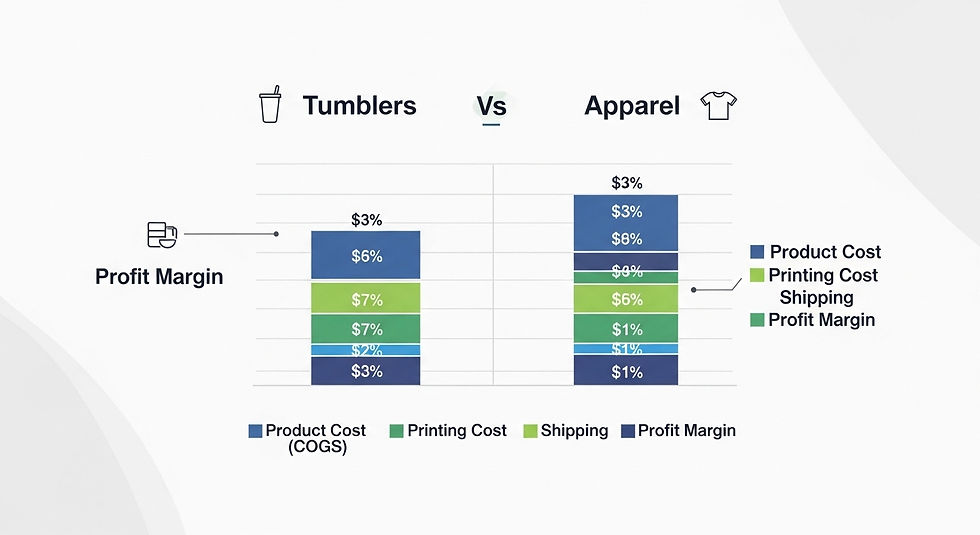
That's a healthy margin. Tumblers, mugs, and drinkware are genuinely the sweet spot for sublimation businesses — not apparel.
Or maybe I should say it this way: the people making consistent money with sublimation aren't selling t-shirts. They're selling drinkware, ornaments, keychains, and photo panels — products where polyester limitations simply don't exist because the substrate is already polymer-coated.
Apparel math is harder. A custom polyester performance shirt blank costs $8–$14. Selling price on Etsy: $22–$35. Margins tighten fast, especially once you add shipping.
Is Sublimation Printing Saturated in 2026?
Short answer: the generic market is. The niche market isn't.
Search "custom tumbler" on Etsy and you'll find 200,000+ listings. Most of them look identical. Competing on "custom tumbler" as a keyword or product category in 2026 is genuinely difficult without differentiation.
But here's what actually works — and I've seen conflicting data on this across forums, so I'll give you my read: sellers who build a niche identity (custom teacher gifts, sports team drinkware, personalized pet memorial products) consistently outperform general "custom everything" shops. The product is the same. The positioning isn't.
Some experts argue that sublimation is too saturated to enter now. That's valid if your plan is to list generic mugs with no marketing strategy. But if you're entering a specific occasion-based or identity-based niche, the market is still underserved at the personalized, higher-AOV end.
Is sublimation printing a good business in 2026? For the right niche, yes. According to Grand View Research (2024), the dye sublimation market is growing at 11.3% annually, driven by demand for customized merchandise. Profitability depends on product selection — drinkware and hard goods outperform apparel due to lower blank costs and no fabric limitations.
How saturated is the sublimation business market? Generic product categories (custom mugs, basic tumblers) are highly competitive on platforms like Etsy. According to sellers in active print-on-demand communities, niche-specific positioning — seasonal products, sports teams, personalized gifting — consistently yields higher conversion rates and lower ad spend than broad "custom print" stores.
What products sell best in a sublimation business? Drinkware (tumblers, mugs), ornaments, photo panels, and keychains tend to generate the strongest margins in home-based sublimation operations. Apparel is possible but constrained by the polyester-only limitation of sublimation ink chemistry.
How to Price Your Sublimation Products Without Burning Out
Most beginners undercharge. This is the number one reason sublimation side-hustles die within six months.
The standard pricing formula used by experienced sellers:
Price = (COGS × 3) + platform fees + desired hourly rate for production time
If your tumbler costs $6.30 to make and takes 15 minutes of active production time (at a modest $15/hour value of your time), your floor price is:
$6.30 × 3 = $18.90 + $0.25 (15 min labor) + ~$1.60 (Etsy fees on $20 item) = $20.75 minimum
Sell below that and you're subsidizing your customers' gifts with your own time.
Featured Snippet — How-To Block:
To price sublimation products correctly, follow these steps:
Calculate total COGS including blanks, ink, paper, and packaging.
Multiply COGS by 3 to set your base price floor.
Add your production time cost at a minimum of $15/hour.
Add platform transaction fees (6.5% for Etsy).
Never price below this number — adjust by raising perceived value, not lowering price.
Charging $12 for a tumbler because you saw a competitor doing it isn't a strategy. It's a race you can't win.
Sublimation vs Print-on-Demand: Which Makes More Sense?
This comparison matters because most people researching sublimation have already looked at Printful or Printify and found the margins thin.
Featured Snippet — Comparison Block:
Sublimation printing vs print-on-demand (POD): Sublimation is better suited for sellers who want higher margins and control over production, because you own the equipment and fulfill orders yourself. POD works better when you want zero inventory risk and are willing to accept 15–25% margins. The key difference is capital upfront vs margin over time.
Home sublimation wins on margin. POD wins on risk.
If you can invest $700–$900, fulfill 5–10 orders a week consistently, and build a niche brand, sublimation will outperform POD within 3–4 months of sales. If you want to test product ideas with zero commitment, POD is the right starting point.
Voice Search / AEO Q&A
Q: What's the best product to sell with a sublimation printer?
A: Drinkware — especially 20oz tumblers and 11oz mugs — offers the best margins for home sublimation businesses. Blank costs are low, the polyester limitation doesn't apply, and personalized drinkware has consistent demand year-round.
Q: How much does it cost to start a sublimation business from home?
A: A functional entry-level setup costs $600–$900, including a Sawgrass SG500 printer, a basic heat press, starter blanks, and sublimation paper. Budget an additional $150–$300 for initial inventory.
Q: Should I start a sublimation business or use print-on-demand?
A: Start with print-on-demand if you have under $300 to invest or want to validate a product idea. Switch to or start with sublimation if you're ready to invest $700+ and want margins above 50%.
Q: Why does sublimation not work on cotton shirts?
A: Sublimation ink requires polyester or polymer-coated surfaces to bond. Cotton fibers don't hold the dye, causing faded, washed-out results. For cotton printing, DTG or screen printing are the correct methods.
Q: When should I scale my sublimation business beyond a side hustle?
A: When you're consistently fulfilling 20+ orders per week and your net monthly profit (after COGS, platform fees, and your own time) exceeds $800–$1,000 for two consecutive months — that's your signal to reinvest in larger equipment or a second heat press.


Comments