
The Ultimate DTF Supplies Buying Guide: Printers, Film, Ink & Powder Explained

The right DTF supplies determine whether your transfers peel clean, hold color, and survive 50+ washes, or crack and fade within weeks. Buying DTF supplies means choosing four core items correctly: a DTF printer, transfer film, DTF ink, and DTF powder, each matched to your volume and budget. This guide breaks down every supply category, what specs actually matter, and the mistakes that cost new shop owners the most money.
You will learn how to size a printer for your order volume, read film and powder specs like a pro, and build a supply checklist you can hand to any vendor.
What Counts as DTF Supplies?
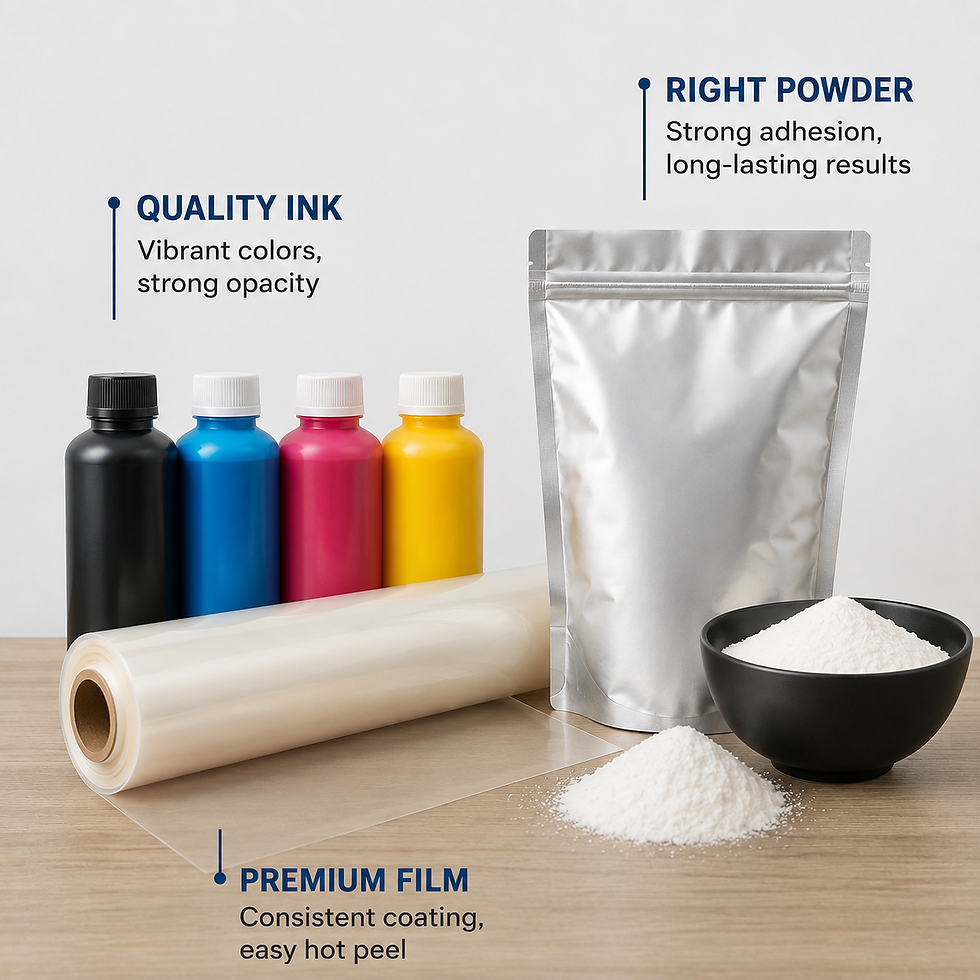
Direct-to-film (DTF) printing requires four core supplies working together as a system. Weak film pairs poorly with strong ink. Every component affects the others.
Your core DTF supplies list includes:
DTF printer (the machine that prints your design onto film)
DTF transfer film (PET film that carries the printed image)
DTF ink (CMYK plus white ink for opacity on dark garments)
DTF powder (hot melt adhesive that bonds the transfer to fabric)
Heat press (applies heat and pressure to finish the transfer)
Skipping research on any one item creates a bottleneck for your whole operation.
Choosing a DTF Printer: Match the Machine to Your Volume
Your printer choice depends on order volume, not brand hype.
Entry-Level Shops (Under 50 Transfers a Day)
A 12 to 16.5 inch all-in-one DTF printer with a built-in powder shaker handles small-batch production well. Rustic United 16.5" All-in-One DTF Printer with Powder Shaker, available from Alpha Print Supply, covers this range, combining two production steps into one machine and saving floor space.
Growing Shops (50 to 200 Transfers a Day)
At this volume, a dedicated print engine with a separate powder shaker gives you more consistent output. The Mimaki TxF150-75 DTF printer fits shops scaling past hobby-level production.
High-Volume Production (200+ Transfers a Day)
Industrial roll-to-roll systems like the STS Inks XPD-924D DTF printer are built for continuous runs. Pair it with a 24" automatic powder shaker, such as the STS Automatic S-20, to avoid a manual powder bottleneck.
Actionable tip: Calculate your daily order volume for the next 12 months before buying. Undersized printers get replaced within a year; oversized printers sit idle and lose value.
DTF Transfer Film: Reading the Specs That Matter
DTF film thickness ranges from roughly 75 to 100 microns. Thinner film peels faster but tears more easily. Thicker film resists tearing but needs slightly longer cure time.
Look for these three specs before buying:
Peel type: hot peel (removed while warm) vs. cold peel (removed after cooling); hot peel speeds up production
Coating consistency: matte double-side coating improves ink adhesion and powder pickup
Roll width: match film width to your printer's print head, common widths are 12", 16.5", and 24"
Alpha Print Supply's Ultra Premium Double Matte Hot Peel film comes in all three widths on 328-foot rolls, giving shops of any size a consistent, tested option.
DTF Ink: What Separates Good Ink From Bad Ink
DTF ink quality shows up in three places: color vibrancy, white ink opacity, and nozzle clog rate. Low-quality white ink settles fast and clogs print heads within weeks.
Check these factors before purchasing:
Particle size: finer pigment particles reduce clogging risk
Opacity on dark fabric: test white ink on black cotton before committing to a bulk order
Shelf life: most DTF ink lasts 12 to 18 months unopened when stored below 77°F
Alpha Print Supply carries Rustic United DTF Inks and STS Inks XPD2, both tested for consistent opacity and lower clog rates. If your current ink already causes streaking or fading, a supply switch often fixes the problem faster than adjusting printer settings.
DTF Powder: Matching Adhesive to Fabric Type
DTF powder is the hot melt adhesive that bonds your printed transfer to fabric. Fine powder suits detailed designs, standard powder suits bold, solid graphics.
Powder color also matters:
White powder works on light and dark garments without showing through
Black powder can show as a shadow on light fabric, so reserve it for dark-only production
Cure temperature for most TPU hot melt powder falls between 300°F and 320°F, with a cure time of 60 to 90 seconds. Curing too hot or too long makes transfers stiff and prone to cracking.
Alpha Print Supply's Rustic United TPU hot melt powder is available in fine and premium grades, and pairs well with the 24" STS Automatic S-20 Powder Shaker for even coverage.
Heat Press Equipment: The Final Step
Your heat press locks the transfer onto fabric with pressure and heat. Most DTF transfers press at 300°F to 325°F for 10 to 15 seconds with firm, even pressure.
Auto-open presses save time on high-volume days. Manual clamshell presses cost less upfront and work fine for shops under 50 transfers a day.
Your DTF Supply Buying Checklist
Before you order anything, confirm:
Your average daily and monthly order volume
Your printer's film width compatibility
Whether you need hot peel or cold peel film
Your fabric mix, to guide powder color choice
Common Buying Mistakes to Avoid
New shop owners lose money in predictable ways:
Buying mismatched film and powder. Film and powder from different manufacturers sometimes bond poorly. Test a small batch before ordering in bulk.
Skipping ink storage rules. Ink stored above 77°F degrades faster and clogs print heads sooner.
Underestimating heat press capacity. A press too small for your transfer size forces multiple presses per garment, doubling labor time.
Final Thoughts: Build Your DTF Supply Chain the Right Way
Your DTF supplies work as one connected system, not four separate purchases. Choosing the right printer, film, ink, and powder together sets you up for consistent, professional transfers from day one. Guessing on any single component, especially film and powder pairing, wastes money on reprints. Alpha Print Supply stocks tested DTF printers, film, ink, and powder built to work together, backed by real customer support. Ready to build your supply list the right way? Reach out to Alpha Print Supply today for personalized recommendations matched to your volume and budget.
Frequently Asked Questions
1. What DTF supplies do I need to get started? You need a DTF printer, transfer film, CMYK and white ink, hot melt powder, and a heat press. Most beginners start with an all-in-one printer that includes a built-in powder shaker to simplify the workflow. Budget for consumables separately, since these are ongoing costs, not one-time purchases.
2. How much do DTF supplies cost per transfer? Cost per transfer typically ranges from $0.50 to $1.50 depending on design size and ink coverage. Film, ink, and powder usage all factor in. Buying consumables in bulk from a single supplier usually lowers your per-transfer cost.
3. What is the difference between hot peel and cold peel DTF film? Hot peel film is removed from the garment while still warm, which speeds up production. Cold peel film must cool completely before peeling, which can improve certain finish textures. Most standard production runs use hot peel film for efficiency.
4. How do I know if my DTF ink is going bad? Signs include streaking, faded colors, or clogged nozzles even after cleaning. Ink typically lasts 12 to 18 months unopened when stored below 77°F. If prints look inconsistent despite proper maintenance, replacing your ink often solves the issue.
5. Can I mix DTF film and powder from different brands? You can, but results vary depending on coating and adhesive compatibility. Testing a small batch before a bulk run prevents wasted film. Sticking with tested, compatible combinations reduces the risk of adhesion failure.


Comments