
Black vs. White DTF Powder: Stopping Dye Migration on Polyester

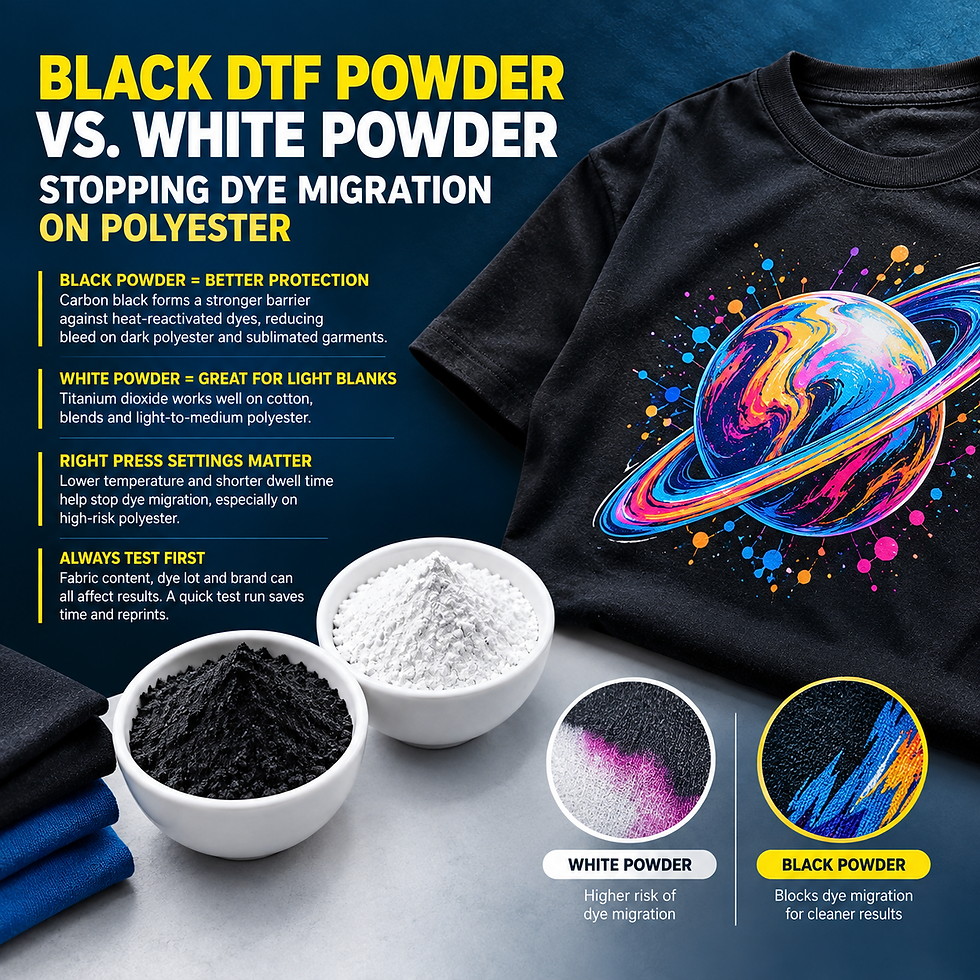
Black DTF powder stops dye migration better than white powder on dark polyester and sublimated garments because carbon black acts as a physical barrier that blocks heat-reactivated dyes from bleeding into your print. This guide breaks down how each powder works, when to use black over white, and how to set up your press for clean results on the hardest blanks you'll run.
Dye migration ruins more DTF transfers than bad film or weak ink ever will. You press a clean white design onto a red or black polyester shirt, pull the press, and watch the white turn pink or gray in seconds. This blog explains the science behind that problem and shows you exactly which powder stops it.
What Causes Dye Migration on Polyester and Sublimated Garments
Dye migration happens when heat reactivates disperse dyes already inside polyester fibers. Those dyes turn into gas under press heat, rise through the fabric, and contaminate your ink layer before it fully cures. This is a chemical reaction tied to the fabric, not a printing mistake.
Polyester content above 65% raises migration risk sharply
Sublimated garments (jerseys, activewear, dye-sub blanks) carry pre-set dye that reactivates fast
Bold or dark dye colors (red, navy, black) migrate more aggressively than pastels
Press temperatures above 320°F speed up the gas transfer
Every shop running sports uniforms, camo, or dark polyester eventually hits this wall. The fix isn't better ink. It's the right adhesive powder.
White Powder vs. Black Powder: The Core Difference
Both powders use the same TPU (thermoplastic polyurethane) hot-melt base. The difference is the pigment mixed into that base.
White DTF powder uses titanium dioxide (TiO2) for opacity. It's invisible under ink on any garment color and works fine for cotton, blends, and light-to-medium polyester.
Black DTF powder uses carbon black instead. That pigment does two jobs: it hides powder haze at transfer edges on dark fabric, and it physically blocks the migration path dye gas travels through.
Feature | White DTF Powder | Black DTF Powder |
Pigment | Titanium dioxide (TiO2) | Carbon black |
Best for | Cotton, blends, light/medium polyester | Dark polyester, sublimated, camo, "bleeder" fabrics |
Melt point | Approx. 225–248°F | Approx. 225–248°F |
Particle size | 70–170 microns (fine to medium) | 70–170 microns (fine to medium) |
Visibility on dark fabric | Can show as white haze at edges | Blends in, no visible haze |
Dye migration resistance | Moderate | High |
Wash durability | 50+ home washes with proper cure | 50+ home washes with proper cure |
How Black Powder Actually Blocks Dye Migration
Carbon black is dense and opaque at the molecular level. When it melts into a solid layer between your ink and the garment, it forms a tighter barrier than the lighter TiO2 layer in white powder. Think of it as a firewall: dye gas still tries to rise during pressing, but the denser carbon layer slows and traps more of it before it reaches your ink.
This matters most on:
Pure polyester and poly-spandex jerseys
Sublimated garments with pre-printed dye already baked into the fibers
Safety-color or neon blanks where bleed shows instantly
Camo and heavily dyed prints with multiple dye layers stacked
Black powder reduces migration but doesn't eliminate it alone. On high-risk polyester, pair it with a lower press temperature and shorter dwell time.
When to Use Black Powder vs. White Powder
Not every job needs black powder. Use this breakdown to decide fast:
Use white powder when: the blank is cotton, poly-cotton under 50% polyester, or light-colored, and the design has no fine open areas exposing bare fabric.
Use black powder when: the garment is dark polyester, sublimated, or a known "bleeder" fabric, or your design has small open gaps (like the inside of a letter "O") that would otherwise show white haze.
Press Settings for Reliable Results
Getting the powder right only matters if your press settings match it. Both powder types share a similar workflow, but polyester blanks need tighter control.
Setting | Standard Blend | Dark Polyester / Sublimated |
Press temperature | 300–325°F | 280–300°F |
Dwell time | 12–15 seconds | 8–10 seconds |
Pressure | Medium | Medium to firm, even |
Peel method | Hot or cold peel per film | Cold peel recommended |
Lower heat and shorter dwell time reduce dye gas release at the source. Combine that with black anti-migration powder and you get two layers of protection instead of one.
For shops running high volumes, a reliable applicator matters too. Alpha Print Supply's 24" STS Automatic S-20 Powder Shaker applies an even coat across every print, which matters most on dark polyester where uneven powder means visible gaps or haze.
Always Test Before You Run Production
No powder claim replaces a pressed, cooled garment. Migration risk changes by fabric percentage, dye lot, and garment brand, even within the same color name. Before committing to a full production run:
Press one test transfer on the actual blank, not a similar one
Let it cool fully before judging color shift; migration often shows more after cooling
Check edges and open design areas for haze or bleed
Repeat the test whenever you switch garment suppliers, even for the same color
Alpha Print Supply carries Rustic United TPU hot-melt powder, formulated for strong opacity and dye-migration resistance on the polyester and sublimated blanks that give shops the most trouble.
Get Cleaner Transfers on Every Blank
Dye migration is a fabric problem, not a printer problem. The right powder choice, matched to lower press temperatures and a proper test run, solves it on the garments that cause the most rework.
If you're still fighting pink whites and dirty edges on dark polyester, Alpha Print Supply can help you build the right consumables stack for your shop. Browse our full DTF consumables lineup to match powder, film, and ink to the blanks you run most and stop losing transfers to dye bleed.
Also explore our complete selection of DTF printers to create consistent, professional quality transfers.
Frequently Asked Questions
Does black DTF powder work on white or light garments?
Yes, but it's not necessary. Black powder blends in on dark fabric, but on light shirts it can show as a faint gray tint in thin ink areas. Save it for dark polyester and sublimated blanks.
Can black powder completely stop dye migration?
No single product eliminates dye migration alone. Black powder significantly reduces bleed-through compared to white powder, but you still need lower press temperature and shorter dwell time on high-risk polyester.
Is black DTF powder more expensive than white powder?
Pricing is typically close, since both use the same TPU hot-melt base with a different pigment. Any cost gap is minor compared to reprinting a batch ruined by dye migration.
Do I need different press settings for black powder versus white powder?
The powders share the same melt point and cure time, so settings don't change based on color alone. What changes is the garment: dark polyester and sublimated fabrics need lower temperature and shorter dwell time either way.
How do I know if a blank will have dye migration problems? Check the polyester content on the tag; anything above 65% carries elevated risk, and sublimated garments carry it by design. The only sure way to know is to press one test transfer and let it cool before judging the result.


Comments