
DTF vs Screen Printing: Which Method Should You Choose?
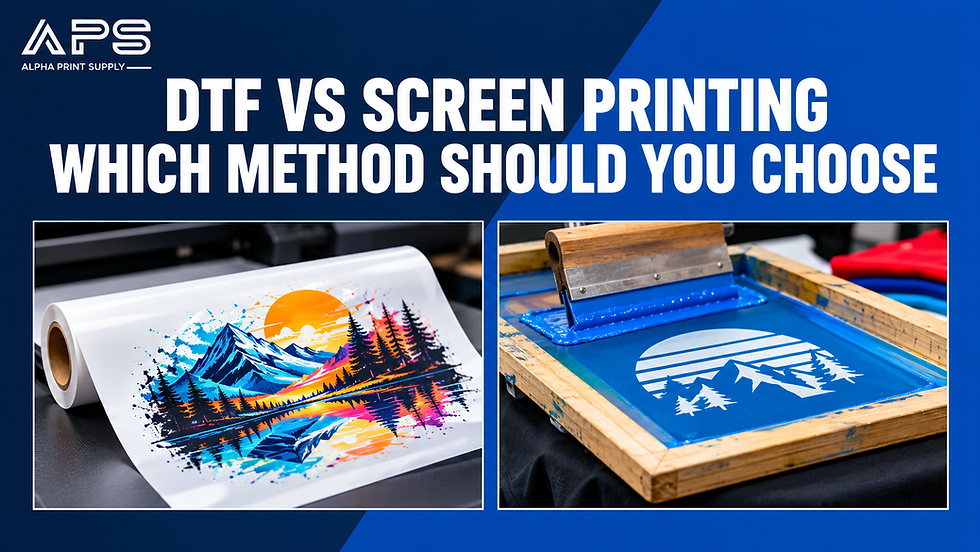
DTF (Direct-to-Film) printing wins for small orders, full-color designs, and fast turnaround, while screen printing wins for large bulk orders with simple, solid-color designs where cost per piece matters most. Neither method is universally "better." The right choice depends on your order size, your design's color count, your fabric, and how many washes the print needs to survive.
This guide breaks down DTF vs screen printing across cost, durability, fabric compatibility, and turnaround time, so you can pick the method that actually fits your project instead of guessing.
What Is Screen Printing?
Screen printing pushes ink through a fine mesh stencil, one screen per color, directly onto fabric. It's the oldest commercial method still in wide use today, and for good reason.
Ink bonds into the fabric fibers, creating a soft, breathable finish.
Each color requires its own screen, costing $15 to $35 per color.
Most shops need 24 to 72 pieces minimum to make the setup cost worthwhile.
Properly cured plastisol ink can outlast the garment itself, often surviving 50 or more wash cycles.
Screen printing shines when you're printing hundreds of identical shirts with one to six solid colors. It struggles with photo-realistic designs, gradients, and small orders where setup costs eat your margin.
What Is DTF Printing?
DTF printing (Direct-to-Film) prints your design onto a special film using water-based inks, coats it with adhesive powder, then heat-presses it onto the fabric. There's no screen burning and no color limit.
No setup cost and no minimum order, so one shirt costs the same per unit as fifty.
Handles unlimited colors, gradients, and photo-quality detail.
Works on cotton, polyester, blends, nylon, leather, and dark fabrics without extra steps.
Modern DTF transfers hold up for 50 to 80+ washes with proper care.
DTF has become the go-to for small businesses, print-on-demand sellers, and shops that need fast turnaround on detailed, multi-color artwork.
DTF vs Screen Printing: Key Differences
Here's the direct comparison that matters most when you're deciding between the two.
Factor | Screen Printing | DTF Printing |
Setup cost | $15–$35 per color | None |
Minimum order | 24–72 pieces (typical) | 1 piece |
Cost at 10 pieces | Higher (setup not spread out) | Lower |
Cost at 500+ pieces | $0.60–$1.20 per shirt | $3–$6 per shirt |
Color limit | 1–6 colors typical | Unlimited, full color |
Fabric range | Best on cotton | Cotton, poly, blends, nylon, leather |
Durability | 50+ washes, can outlast garment | 50–80+ washes with proper care |
Turnaround | 5–14 days | Same day to 2–3 days |
Hand feel | Soft, ink integrated into fabric | Slightly raised, flexible film |
Cost Comparison: Where Each Method Wins
The break-even point between DTF and screen printing typically falls between 24 and 100 pieces, depending on your design's color count. Under that range, DTF almost always wins because there's zero setup fee. Above it, screen printing's per-shirt cost keeps dropping as volume climbs, since the screen cost gets spread across more units.
A simple rule: if your order is under 50 pieces or your design has more than six colors, DTF printing is your cheaper, faster option. If you're ordering 100+ pieces of a one- or two-color logo, screen printing will save you money per shirt.
Durability and Wash Testing
Both methods survive 50 or more wash cycles when applied and cured correctly. A well-cured screen print on 100% cotton holds a slight edge at the very high end of durability, sometimes outlasting the shirt itself. DTF transfers flex better with stretchy fabrics and resist cracking on blends, but they can lose a small amount of vibrancy after heavy washing if care instructions aren't followed.
For daily-wear uniforms or industrial workwear, screen printing or embroidery is usually the safer bet. For promotional apparel, event shirts, and team gear, DTF holds up more than well enough.
Fabric Compatibility
This is where DTF printing clearly separates itself. Screen printing performs best on 100% cotton and struggles with performance fabrics, nylon, and stretchy blends. DTF transfers apply cleanly to cotton, polyester, tri-blends, fleece, nylon, and even leather, with no pretreatment needed. If your product line includes athletic wear, hats, or bags in mixed materials, DTF gives you far more flexibility.
Color and Design Complexity
Screen printing costs more with every additional color, since each one needs its own screen. Complex, photo-realistic artwork or gradients quickly becomes impractical and expensive. DTF prints unlimited colors for the same flat cost, making it the clear winner for detailed logos, photographs, and full-color graphics.

Turnaround Time
Screens need to be burned, tested, and set up before a single shirt runs, which typically takes 5 to 14 days. DTF transfers can be printed and pressed the same day, or within 1 to 3 business days through a supplier. If you're on a tight deadline, DTF is almost always the faster path.
Which Method Should You Choose?
Match the method to your actual job, not to trends.
Choose DTF if: your order is under 50 pieces, your design uses multiple colors or photo detail, you need fast turnaround, or you're printing on mixed or dark fabrics.
Choose screen printing if: you're ordering 100+ pieces of a one- to three-color design, you need maximum long-term durability, and per-unit cost at scale is your top priority.
Combine both: many shops use screen printing for bulk basics and DTF for small custom runs, personalized names, or rush orders.
How Alpha Print Supply Helps You Decide
Choosing between DTF vs screen printing gets easier when you have the right materials and equipment behind you. Alpha Print Supply stocks premium DTF film, adhesive powder, and transfer-ready inks for shops running small, detailed, or fast-turnaround jobs and for the shops handling higher-volume production. If you're testing both methods before committing to one workflow, exploring Alpha Print Supply's DTF starter kits can help you compare real results on your own equipment before scaling up.
Final Verdict: Print Smart, Not Just Fast
There's no single winner in the DTF vs screen printing debate; there's only the right tool for your specific order. Small runs, full color, and quick deadlines point to DTF. Large runs, simple designs, and long-term durability point to screen printing. Know your quantity, know your colors, and the decision makes itself.
When you're ready to source reliable materials for either method, explore Alpha Print Supply’s professional DTF printers, high-quality supplies and expert guidance to find the right solution for your business.
Frequently Asked Questions
Is DTF cheaper than screen printing?
For orders under roughly 50 pieces, yes, because DTF has no setup or screen cost. Above 100 pieces with a simple one- or two-color design, screen printing usually becomes cheaper per shirt. The exact break-even point shifts based on your design's color count and fabric choice.
Does DTF last as long as screen printing?
Modern DTF transfers hold up for 50 to 80+ washes with proper care, which matches or comes close to screen printing's durability. A well-cured screen print on cotton can slightly outlast DTF at the extreme high end. For most everyday apparel, the difference won't be noticeable.
Can DTF be used on any fabric?
Yes, DTF works on cotton, polyester, blends, nylon, fleece, and even leather without pretreatment. Screen printing performs best on 100% cotton and can struggle with stretchy or synthetic fabrics. This makes DTF the more versatile choice for mixed product lines.
Which method is better for small businesses?
DTF is generally better for small businesses and startups because it has no minimum order and no setup fee. You can print one shirt or fifty at the same cost per unit. Screen printing only becomes cost-effective once you're ordering in bulk.
What's the minimum order for screen printing? Most shops require 24 to 72 pieces per design to make screen printing economical, since screen costs are fixed regardless of quantity. Below that range, the setup fee gets spread across too few units, making the per-shirt cost high. DTF has no minimum, so it fills that gap for smaller orders.


Comments