
DTF vs. Screen Printing Cost Comparison: Which Method Saves You Money in 2026?
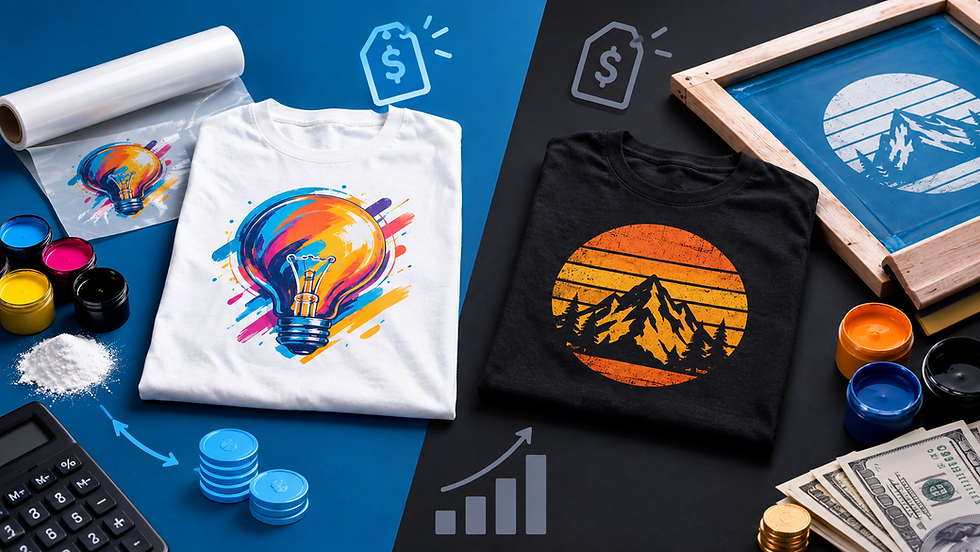
DTF printing costs less per piece on small runs, typically under 25 to 50 units, since it has no setup fees or color limits. Screen printing costs less per piece on large runs of a single design, usually 500 or more units, since its per-color setup fee spreads thin across volume. This guide compares both methods side by side across setup costs, hidden costs, and per-piece pricing at small, medium, and large order sizes, so you can price jobs correctly and protect your margins.
DTF Printing Costs: The Complete Breakdown
DTF transfers work on a flat-cost model. Your design prints onto PET film with CMYK plus white ink, gets coated in adhesive powder, cures, then heat-presses onto the garment.
Setup Costs
DTF has no per-job setup cost. No screens, no color separations, no minimum order quantity. Load your design into RIP software and print, whether the order is one shirt or five hundred.
Hidden Costs
DTF's flat price hides a few real costs if your equipment isn't dialed in:
Ink waste: aggressive printhead cleanings from white ink clogging can waste up to 15% of ink weekly
Film waste: poorly nested gang sheets can leave 20% of film unused, up to 38% on single, un-gang-sheeted prints
Misprint rate: clogs, banding, and calibration drift typically cause a 3 to 5% waste rate
Utilities: a curing oven at roughly 300°F adds about $0.05 to $0.10 per shirt
Equipment upkeep: printheads, dampers, and RIP licenses need periodic replacement or renewal
Cost Per Piece by Order Size
Small orders (up to 25 pieces): $1.05 to $1.95 per piece, all-in, from piece one.
Medium orders (26 to 100 pieces): Same $1.05 to $1.95 range, though raw materials alone often run $0.43 to $0.90 per shirt once you buy film and ink in bulk rolls.
Large orders (500+ pieces): DTF stays essentially flat. Bulk buying trims a few cents per piece, but there's no equivalent to screen printing's setup-fee dilution.
Screen Printing Costs: The Complete Breakdown
Screen printing pushes plastisol ink through a mesh stencil, one screen per color, then cures it in a conveyor dryer. It runs on a declining-cost curve, not a flat one.
Setup Costs
Screen printing carries a real per-job setup fee:
$25 to $45 per color to burn the design onto mesh
$15 per color for film separations
$25 press setup fee per print location
A 3-color design can carry $130 to $150 in one-time prep charges before a single shirt gets printed. Most shops only charge this on orders of 24 to 50 pieces or fewer.
Hidden Costs
Screen printing carries ongoing overhead that rarely shows on the invoice:
Screen reclaiming: cleaning and stripping emulsion between jobs adds labor and consumable cost with every reorder
Reorder fees: shops that don't store screens charge again to reburn them for a repeat design
Spoilage buffer: a 3 to 5% garment loss for misprints and press-start waste is standard
Amortized maintenance: squeegee resurfacing and ink rotation run roughly $0.10 to $0.20 per shirt yearly
Downtime: setup, reclaiming, and alignment fixes cost labor hours even when the press isn't printing
Cost Per Piece by Order Size
Small orders (up to 25 pieces): Premium pricing. Setup charges are absorbed by very few pieces, so a small run commonly lands at $8 to $15 per shirt all-in, garment included.
Medium orders (26 to 100 pieces): This is where the curve bends. Per-piece cost can drop by roughly half between 12 and 50 pieces, and a real 100-piece order commonly quotes around $12 per shirt all-in.
Large orders (500+ pieces): $0.60 to $1.20 per shirt for a simple 1 to 2 color design, sometimes falling under $1 per print. This is where the setup fee stops mattering and per-piece cost hits its lowest point.
Screen printing also requires more equipment investment than DTF. A basic manual press with dryer and exposure unit runs $5,000 to $15,000; a mid-range automatic setup runs $30,000 to $80,000.
The Break-Even Point: Where the Two Methods Cross
Neither method is cheaper in every scenario. It depends on order size and how many colors are in the design.
For a standard 1 to 2 color design, the crossover point where screen printing's per-piece cost drops below DTF's flat rate typically falls between 75 and 150 units. Below that, DTF's lack of setup fees keeps it ahead. Above it, screen printing's declining curve takes over.

For designs with 5 or more colors, gradients, or photo-realistic art, that crossover shifts to 300 units or more, since every added color adds another screen to the screen printing side, while DTF's price stays the same regardless of color count.
Quick reference:
Under 25 to 50 pieces: DTF
75 to 150 pieces, simple design: run the numbers both ways
500+ pieces, simple design: screen printing is typically lowest
Any quantity, complex or multi-color art: DTF
Beyond Price: Durability and Fabric Compatibility
A cheaper print that fails fast costs you more in reprints and reputation.
A properly pressed DTF transfer holds up to 50 wash cycles under standard care, and 80 or more under optimal aftercare. Screen prints on cotton typically survive 50 to 100+ wash cycles. DTF fades and thins over time; screen prints tend to crack.
DTF bonds to cotton, polyester, blends, canvas, denim, and performance fabrics. Screen printing performs best on cotton and cotton-rich blends and struggles more with synthetics.
If your shop handles mixed fabric or activewear orders, DTF's wider compatibility often outweighs a marginal per-piece cost difference.
How Alpha Print Supply Helps You Run Both Methods Profitably
Most successful shops don't pick one method exclusively. They run DTF for small, colorful, mixed-fabric orders and reserve screen printing for high-volume, simple designs.
Alpha Print Supply supplies the equipment and consumables that keep your DTF side profitable: reliable DTF printers sized to your daily volume, plus the PET films, inks, and transfer powders that determine whether your cost-per-shirt stays where you quoted it. If clogging, uneven powder adhesion, or inconsistent film is quietly inflating your real cost per unit, upgrading your consumables and equipment reliability is usually the fastest way to protect that margin.
Final Words: Print Smarter, Not Just Cheaper
The cheapest method on paper isn't always the most profitable choice for your order. Match your process to order size, color count, and fabric, and you'll price every job correctly instead of guessing. Run the break-even math before you quote your next job. If you're scaling DTF production, explore what Alpha Print Supply offers for printers, films, inks, and powders suited to your shop's volume.
Frequently Asked Questions
Is DTF cheaper than screen printing?
For small orders, yes. DTF costs $1.05 to $1.95 per piece with no setup fees, while screen printing carries $25 to $45 per color in prep charges. Under roughly 50 pieces, DTF almost always wins on cost.
At what quantity does screen printing become cheaper?
The crossover point typically falls between 75 and 150 units for a simple 1 to 2 color design. Multi-color designs push that crossover to 300 units or higher, since DTF has no per-color penalty.
Does DTF last as long as screen printing?
Both hold up well when applied correctly. DTF transfers last 50 to 80+ wash cycles, while screen prints last 50 to 100+ wash cycles on cotton. Application quality matters more than the method itself.
Can DTF print on any fabric?
DTF bonds to cotton, polyester, blends, canvas, denim, and performance fabrics, giving it wider compatibility than screen printing, which performs best on cotton and cotton-rich blends.
Should my shop offer both DTF and screen printing?
Most profitable shops run both. Use DTF for small runs, complex designs, and mixed fabrics, and reserve screen printing for large, simple orders where setup cost spreads thin.


Comments