
Thicker DTF Film: More Stability, Less Flexibility Explained

Thicker DTF film feels more stable during printing because the added mass resists curling, static, and feed inconsistency, but that same rigidity reduces how well the finished transfer bends and moves with fabric. In simple terms, you're trading hand feel for handling control. This blog breaks down why that trade-off exists, what the numbers say about DTF film thickness, and how to pick the right micron range for your production line without sacrificing print quality or garment comfort.
Why Film Thickness Controls Both Stability and Flexibility
PET film is the base material every DTF transfer starts on. Its thickness, measured in microns, determines how the film behaves in three places: the printer, the curing oven, and the final garment.
A thicker film has more physical mass. That mass resists movement. It won't lift, curl, or shift as easily when heat, static, or feed tension act on it. That's why operators describe thicker film as "more stable."
But the garment doesn't care about your printer's feed path. It cares about how the cured transfer moves when someone wears it. A stiffer film cracks or resists flexing at stress points like elbows, necklines, and seams. Stability and flexibility pull in opposite directions, and understanding that trade-off is the first step to choosing correctly.
What Thicker DTF Film Actually Improves
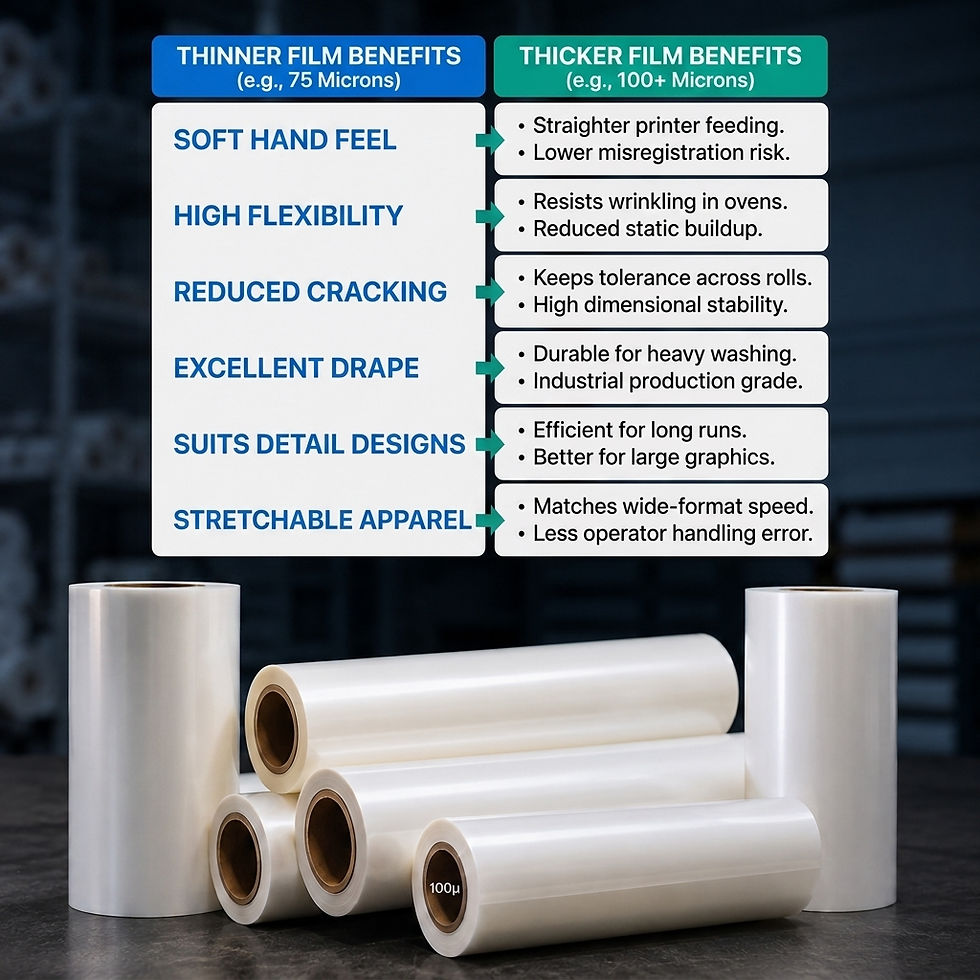
Thicker film, typically in the 100 to 120 micron range, delivers real, measurable production benefits:
Straighter feeding through wide-format printers, especially on long runs
Better resistance to wrinkling during the curing stage
More predictable peeling on large or detailed designs
Reduced static buildup, which lowers misregistration risk between the white underbase and CMYK layers
Improved dimensional stability, keeping tolerance tight even across a full roll
For shops running high volumes or wide-format jobs, these gains cut reprints and downtime. A film with a tight thickness tolerance, ideally within plus or minus 3 to 5 microns, holds its shape from meter 1 to meter 100 of a roll. That consistency matters more for output quality than the raw thickness number alone.
The Flexibility Trade-Off You Give Up
Here's the cost side of that stability. As DTF film gets thicker, the cured transfer gets stiffer, and stiffness works against comfort and durability on fabric:
Reduced drape, so the transfer sits on top of the fabric instead of moving with it
Higher crack risk at fold points and high-stress areas after repeated washing
Less suitability for stretch fabrics, like athletic wear or fitted apparel
A stiffer hand feel, which customers notice immediately on soft goods
This is why 75 micron film remains the industry default for general apparel. It's thin enough to flex with cotton and poly-blend fabrics, but thick enough to run cleanly through most printers when the coating and tension controls are dialed in.
Standard DTF Film Thickness Range: What the Numbers Show
Commercial DTF film typically falls between 75 and 120 microns. Each range serves a different purpose:
75 microns: The most common baseline. Flexible, lightweight, and well suited to detailed designs and everyday garment printing.
80 to 90 microns: A middle ground that balances soft hand feel with better mechanical stability on the printer.
100 to 120 microns: Stiffer and more durable, better suited to heavy-wash textiles, large-format graphics, or high-speed production runs where feed stability matters more than drape.
Thickness alone isn't a quality grade. A well-coated 75 micron film with consistent release force, generally 5 to 15 grams per centimeter, can outperform an inconsistent 100 micron film that varies from roll to roll. That's why sourcing from a supplier with verified coating and tolerance control matters as much as the micron spec on the label.
For shops that print a mix of detailed apparel and heavier-duty jobs, running two film weights, such as the Rustic United Ultra Premium Double Matte Hot Peel film in both 12" and 16.5" widths, gives you the flexibility to match the film to the job instead of forcing every order through one thickness.
How to Choose the Right Thickness for Your Production
For Everyday Apparel and Detailed Designs
Stick with 75 to 80 micron film. It flexes naturally with cotton, poly-blends, and fitted garments, and it handles fine detail without cracking at seams or fold lines after wash cycles.
For High-Volume or Heavy-Wash Fabrics
Move up to 100 to 120 micron film when you're running long jobs on wide-format printers or printing designs bound for heavy commercial laundering. The added rigidity reduces misfeeds and keeps registration tight across a full production shift.
Pairing your film choice with a consistent ink and powder system also protects your stability gains. Rustic United DTF Ink and STS Inks are formulated to lay down evenly across both thinner and thicker PET stock, which keeps color accuracy consistent no matter which film weight you're running that day.
If matching film thickness to every order feels like more variable-juggling than your shop has time for, ordering finished DTF transfers directly from a reliable transfer printing service removes the guesswork entirely, since the transfers arrive pre-matched to the fabric type and ready to press.
Closing Perspective: Get the Balance Right, Every Time
Chasing stability or flexibility in isolation leads to wasted film and inconsistent output. The real goal is matching DTF film thickness to the job in front of you, not defaulting to whatever roll is already loaded. Alpha Print Supply stocks multiple film weights and widths built for exactly this kind of decision-making, so you can dial in stability for wide-format runs and flexibility for everyday apparel without switching suppliers.
Browse our full DTF consumables lineup and talk to the team about which thickness fits your current production mix.
Frequently Asked Questions
What is the standard thickness for DTF film? Most commercial DTF film falls between 75 and 120 microns. The 75 micron range is the most common default for general apparel because it balances flexibility with printer feed stability. Thicker options exist for heavier-duty and high-volume applications.
Does thicker DTF film crack more easily? Yes, thicker film tends to crack more at stress points like elbows and seams because it flexes less with the fabric underneath it. Thinner film moves with the garment and resists cracking better over repeated washes, provided it's cured correctly.
Is 75 micron or 100 micron DTF film better? Neither is universally better. 75 micron film suits detailed designs and stretch fabrics, while 100 micron film suits high-speed, high-volume printing where feed stability matters more than drape. The right choice depends on your equipment and the garment type.
Why does my DTF film curl during printing? Curling usually points to inconsistent thickness tolerance or poor coating quality rather than the micron number itself. A tight tolerance, within plus or minus 3 to 5 microns, keeps film lying flat through the printer and oven.
Can I use one film thickness for every job? You can, but you'll compromise either stability on heavy runs or flexibility on wearable apparel. Most production shops keep at least two thickness options on hand to match the film to the specific job instead of settling for average results across the board.


Comments