
The Complete DTF Consumables Guide for Print Shops and Hobbyists
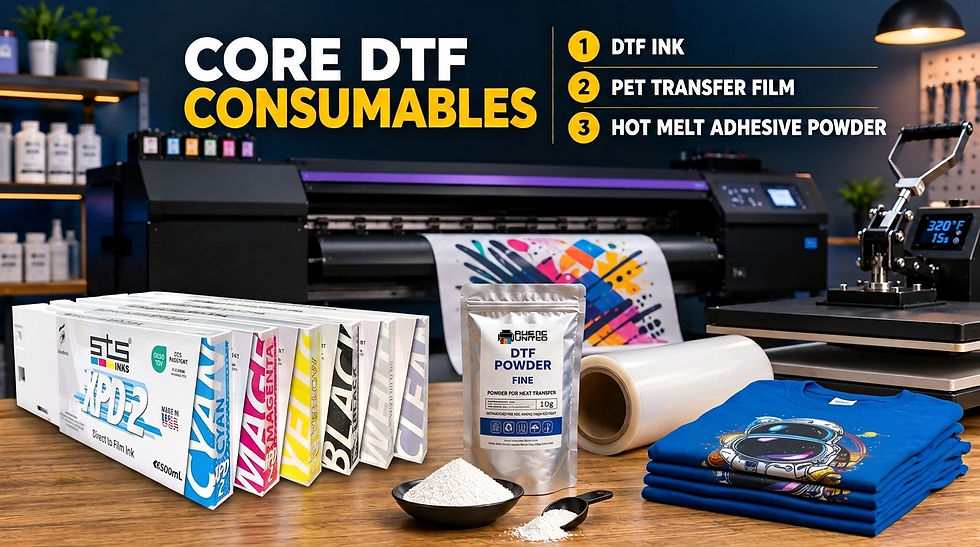
DTF consumables determine whether your prints last for years or peel off after one wash. The three core supplies, film, powder, and ink, work as one system. Get one wrong and the transfer fails, no matter how good your printer is. This guide covers what each consumable does, how to pick the right specs, and how to avoid the mistakes that waste material and money. Whether you run a busy print shop or print custom shirts from your garage, you will know exactly what to buy.
What Are DTF Consumables and Why They Matter
Direct-to-film (DTF) printing relies on three consumables: PET transfer film, hot melt powder, and DTF ink.
Film carries the printed design before it transfers to fabric.
Powder is the adhesive that bonds the ink to the garment.
Ink builds the color and the white underbase.
A weak link breaks the chain. Cheap film curls. Mismatched powder particle size clogs your shaker. Low-grade ink fades after a few washes. Quality consumables are the foundation of every transfer you produce.
DTF Film: Choosing the Right Thickness and Type
Most DTF transfer film ranges from 75 to 100 microns thick. That difference changes how your prints feed, peel, and wear.
75 vs 100 Micron Film: Which One Fits Your Shop
75-micron film is lighter, feeds more easily through desktop and A3 printers, and suits fine, detailed designs.
100-micron film tracks flatter, resists curling, and holds up better on large-format industrial printers running at high speed.
If you print small batches with intricate artwork, start with 75-micron rolls. If you run 24-inch or wider production printers daily, 100-micron gives you more consistent feeding. Alpha Print Supply stocks PET DTF films sized for both workflows, so you can match the film to your printer instead of forcing one spec to do everything.
Hot Peel vs Cold Peel Film
Hot peel film lets you remove the carrier right after pressing, which speeds up production. Cold peel film needs the transfer to cool first, which can improve edge definition on some designs. Most shops default to hot peel for throughput, but test both before committing to a full run.
DTF Powder: Particle Size, Curing, and Application
DTF hot melt powder is 100% TPU, thermoplastic polyurethane, with a typical particle size of 80 to 170 microns. Finer powder gives smoother, softer prints on detailed graphics. Coarser powder covers large solid areas faster with less product.
How to Cure DTF Powder Correctly
Curing is where most beginners lose durability. A few reliable ranges:
Melting temperature: 110°C to 165°C, or 230°F to 330°F, depending on the powder formulation.
Cure time: 50 to 100 seconds in an oven or shaker, or 8 to 15 seconds under a hovering heat press.
Final press: 150°C to 170°C, or 300°F to 340°F, for 10 to 15 seconds with medium, even pressure.
Under-cured powder feels dusty and peels off after one wash. Over-cured powder turns brown or stiff and cracks with wear. Alpha Print Supply's Fine and Premium DTF transfer powders are graded for consistent particle distribution, which cuts down the guesswork on cure time.
An automatic powder shaker removes a huge variable. Manual sprinkling almost always leaves uneven coverage, which shows up as patchy adhesion after the first wash. A shaker unit typically pays for itself within a few hundred transfers.
DTF Inks: Building Color That Lasts
DTF ink systems use CMYK color plus a dedicated white ink underbase. White ink sits between the film and the color layer, and it needs constant agitation to prevent pigment settling. That is why every DTF printer runs a white ink circulation system.
Look for inks with three qualities:
Consistent viscosity that will not clog printheads.
High opacity white for vivid color on dark garments.
Wash-fastness rated for at least 50 industrial washes.
Alpha Print Supply carries Rustic United DTF and UV DTF inks formulated for this balance of opacity, flow, and durability. Matching your ink to your printhead type, such as Epson I1600 versus I3200, matters more than most buyers realize.

Storage and Shelf Life: Protect Your Investment
Consumables degrade faster than most people think.
Film: Store at 15°C to 25°C, or 59°F to 77°F, away from direct sunlight and humidity. The coating is hygroscopic, meaning it absorbs moisture from the air, which weakens adhesion.
Powder: Keep it sealed in a cool, dry container. Humidity causes clumping, which leads to uneven application.
Ink: Store it upright, away from heat, and agitate it before loading into new cartridges.
A cheap bag of powder ruined by humidity costs more in wasted labor than the product itself.
Common Consumable Mistakes That Kill Print Quality
Using expired or clumped powder to save money.
Running film past its shelf life without a quality check.
Skipping the pre-press step that removes garment moisture before transfer.
Guessing at cure temperature instead of testing on a scrap piece.
Buying inconsistent batches from unverified resellers.
Each mistake is preventable with a five-minute test print before a full run.
Building a Reliable Consumables Workflow
Standardize on one film thickness per printer and document the settings.
Log cure temperature and time for every powder batch.
Rotate stock so older film and powder get used first.
Test new ink or powder lots on scrap fabric before a client job.
Source consumables and hardware from one supplier so specs stay compatible.
This consistency separates shops with a 1 to 2 percent reject rate from shops that scrap 10 percent of every run.
Print With Confidence: Your Next Move
Great DTF transfers come down to disciplined consumables management, not luck. Film, powder, and ink each carry precise specs, and hitting them consistently keeps your prints vibrant wash after wash. Alpha Print Supply stocks the film, powder, and inks your shop needs, backed by real support as you dial in new settings.
Browse our complete collection of DTF printers and premium consumables to keep your business printing efficiently and delivering exceptional results.
Frequently Asked Questions
What is the best DTF film thickness for beginners?
75-micron film is the easiest starting point because it feeds smoothly through most desktop and A3 printers. It handles fine detail well and costs less per roll than thicker options. Once you scale to a wider production printer, test 100-micron film for added stability.
How long does DTF powder last in storage?
Sealed and stored in a cool, dry place, DTF powder typically stays usable for 12 to 18 months. Humidity is the main threat, since it causes clumping and uneven melting. Always check for clumps before loading it into a shaker.
What temperature should I use to cure DTF powder?
Most powders cure between 110°C and 165°C, or 230°F to 330°F, for 50 to 100 seconds, depending on the formulation. Always check the manufacturer's data sheet first, since particle size and TPU blend change the ideal range. A quick test print confirms the setting before a full run.
Can I use any DTF ink with any printer?
No. Ink viscosity needs to match your printhead type, such as Epson I1600 or I3200 series heads. Using the wrong ink can clog nozzles or produce weak color opacity. Check compatibility before switching suppliers.
Do I need a powder shaker, or can I apply powder by hand? You can apply powder by hand for small, occasional jobs, but coverage is rarely even. A powder shaker gives consistent application, reduces waste, and speeds up production. For any shop running regular volume, it is one of the fastest equipment upgrades to pay for itself.


Comments