
The Ultimate Guide to DTF White Ink Circulation: Preventing Clogs and Heavy Sediment
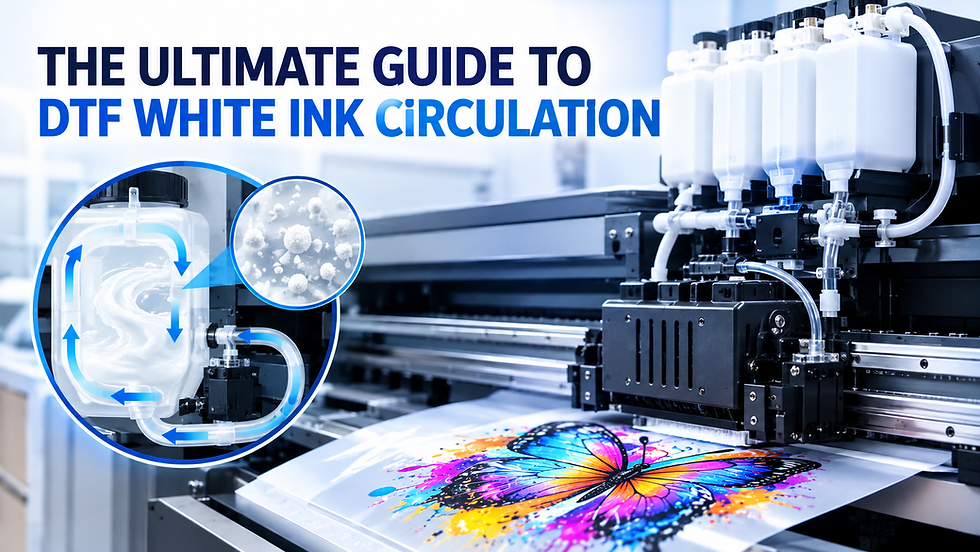
DTF white ink circulation is the process of continuously moving ink between the tank, sub-tank, and printhead to stop heavy titanium dioxide pigment from settling into a sludge that clogs your lines. Without it, white ink separates within hours, not days, making it the leading cause of nozzle blockages in direct-to-film printing.
Quick Answer:
White ink settles because it contains heavy titanium dioxide pigment
Circulate white ink daily for 5 minutes before your first print
Run mid-job maintenance cycles every 25 to 30 minutes on long runs
Keep humidity between 50% and 70% to slow ink drying
Skipped circulation is the top cause of $900+ printhead repairs
Why Does DTF White Ink Clog More Than CMYK Ink?
White DTF ink contains titanium dioxide, a pigment far heavier than the dyes used in CMYK inks. CMYK stays evenly suspended for days. White ink starts settling within hours once it sits still, which is why a printer left idle overnight can show a faint underbase or clogged nozzle the next morning.
Ink Type | Pigment Weight | Settling Time When Idle | Circulation Need |
CMYK Ink | Light | 2 to 5 days | Low |
White Ink | Heavy (titanium dioxide) | Within hours | Continuous |
What Causes DTF White Ink Sediment and Clogs?
Titanium dioxide settling: Pigment sinks into the tank, tube, or damper and forms a thick layer that blocks microscopic nozzle channels
Low humidity: Dry air speeds evaporation; uncapped nozzles can dry out in as little as 30 minutes
Idle printers: Machines left unused for several days allow ink to settle and dry
Weak circulation hardware: Entry-level printers with underpowered pumps let bubbles form, causing streaking or nozzle dropout
How Does a DTF White Ink Circulation System Work?
A proper circulation system pumps ink in a continuous loop, from the main tank through the sub-tank and back, agitating pigment so it never fully settles. Most DTF machines run this automatically; others require a manual cycle, typically 5 minutes at 50% speed, before the day's first print.
If your printer lacks a strong built-in loop, a dedicated circulation splitter installed between the white ink line and pump can recreate that effect.
What Is the Best DTF White Ink Maintenance Schedule?
Consistency beats intensity. Five minutes a day prevents repairs that can cost $900 or more.
Frequency | Task | Why It Matters |
Daily | Gently shake white ink bottle | Re-suspends settled pigment |
Daily | Run circulation for 5 minutes | Clears overnight sediment |
Daily | Print a nozzle check | Catches early blockages |
Every 25 to 30 min | Mid-run cleaning cycle | Stops nozzles drying mid-job |
Weekly | Inspect tubing and capping station | Removes buildup before it hardens |
Monthly | Replace dampers ($15 to $40) | Prevents restricted ink flow |
Monthly | Flush lines with cleaning solution | Clears deep sediment |
Ink quality affects how well this schedule works. Lower-grade white ink separates faster and redeposits sediment even after a fresh flush.

Common DTF White Ink Problems and Fast Fixes
Symptom | Likely Cause | Fast Fix |
Faint or gray underbase | Settled pigment, weak circulation | Run a 5-minute circulation cycle |
Streaking across prints | Air bubbles in the line | Perform a soft cleaning cycle |
Missing nozzle lines | Dried ink or clogged channel | Nozzle check, then soft clean |
Clumpy ink in bottle | Ink sat idle too long | Gently massage the line; never shake hard |
Recurring clogs after cleaning | Low-grade ink or worn damper | Replace damper, upgrade ink quality |
How Do You Fix a Clogged DTF White Ink Line?
Stop printing immediately. Running a partially clogged head causes more damage.
Print a nozzle check to confirm which channels are affected.
Run a soft cleaning cycle through your printer's software before escalating.
Massage the ink line gently if you see settling; never shake it aggressively, since this adds air bubbles.
Flush with a cleaning solution if soft cleaning doesn't restore flow.
How to Choose DTF Ink and Equipment That Resist Sedimentation
Ink quality: Finer, well-milled titanium dioxide particles settle slower than coarse formulations
Printhead type: Epson i3200 and XP600 heads have different tolerance thresholds for pigment density, so match ink viscosity to your head
Film quality: Poor absorption forces extra passes, leaving more ink sitting idle in the lines
Circulation hardware: Stock pumps often struggle once production volume scales up
If you're building or upgrading a DTF print shop, review your ink, film, and circulation hardware together rather than troubleshooting one clog at a time.
Final Thoughts: Keep Your Ink Moving, Keep Your Business Printing
DTF white ink circulation is not optional maintenance, it's the difference between predictable production and unplanned downtime. A five-minute daily routine costs almost nothing. A clogged printhead costs hundreds of dollars and a full day of lost output.
Ready to stop fighting sediment and start printing consistently? Explore Alpha Print Supply's white ink, film, and powder built to work as one system.
Browse our complete collection of DTF printers to keep your business printing efficiently and delivering exceptional results
Frequently Asked Questions
How often should I circulate DTF white ink?
Run circulation daily for about 5 minutes before your first print. On long batches, add a brief maintenance cycle every 25 to 30 minutes so nozzles don't dry out mid-run.
Why does white ink clog more than CMYK ink?
White ink contains titanium dioxide, a pigment much heavier than CMYK dyes. It starts settling within hours of sitting idle, while CMYK can stay suspended for several days without issue.
Can I fix a clogged white ink line myself?
Yes, in most cases. Start with a nozzle check, then run a soft cleaning cycle through your printer's software. If flow doesn't improve, gently massage the line and flush with a cleaning solution rather than shaking the bottle hard.
What humidity level prevents ink drying and clogs?
Keep your workspace between 50% and 70% humidity. Drier air causes ink to evaporate and dry inside the nozzle plate faster, raising your risk of blockages.
How much does a white ink clog typically cost to fix? Ignored clogs can lead to printhead damage costing $900 or more. Routine damper replacement runs $15 to $40, which is far cheaper than replacing a full printhead assembly.


Comments