
Enhancing DTF Printing Efficiency: Strategic Upgrades for Incremental Gains
Updated: 7 hours ago

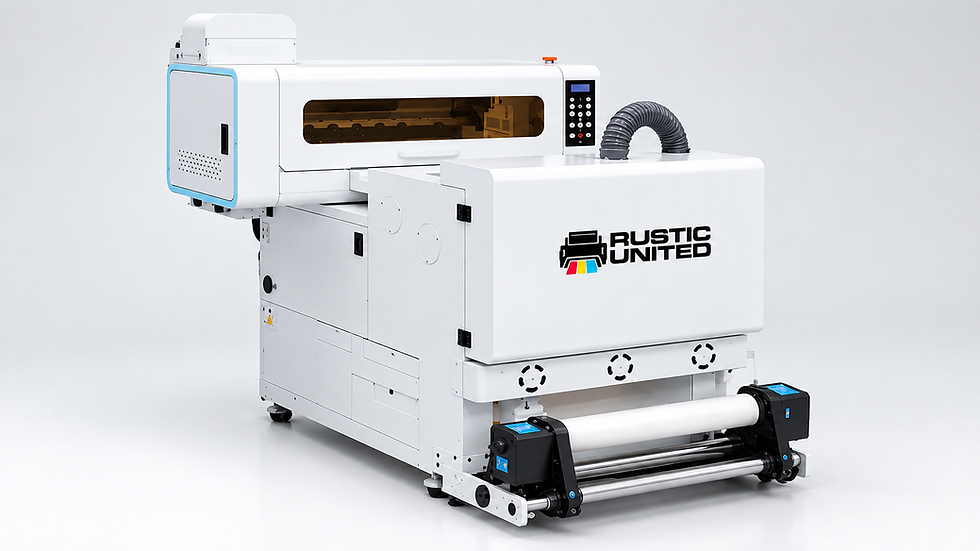
You can boost your DTF printing efficiency without replacing your entire setup. Small, targeted upgrades to your ink, film, powder, curing process, and workflow add up to real gains in output, quality, and profit. This blog breaks down the specific upgrades that move the needle, why each one works, and how to prioritize them based on your shop's current bottleneck.
DTF (Direct-to-Film) printing rewards precision. A shop running the same printer as its competitor can still produce more usable transfers per day by tightening the variables around that printer. Below are the upgrades that deliver the highest return, in the order most shops should tackle them.
What Actually Limits DTF Printing Efficiency
Before you upgrade anything, identify your real bottleneck. Most DTF workflow slowdowns trace back to one of four areas:
Ink and film quality, causing reprints and color drift
Powder application and curing, causing wash failures and cracking
Print queue and file prep, causing idle printer time
Maintenance gaps, causing printhead clogs and downtime
Fixing the wrong area first wastes money. Track your reprint rate for one week before you spend on upgrades. If reprints sit above 5%, start with consumables. If your printer sits idle between jobs, start with workflow.
Strategic Upgrade 1: Move to Higher-Grade Ink
Ink quality controls color accuracy and printhead lifespan. Cheaper pigment inks clog nozzles faster and demand more frequent cleaning, which eats into production hours.
Higher-grade DTF ink with better pigment dispersion cuts clogging and holds color density more consistently across a full print run. This matters most on long gang sheets, where color drift between the first and last transfer is a common complaint.
Alpha Print Supply carries Rustic United DTF Inks and STS Inks XPD2, both formulated for consistent viscosity and lower nozzle clogging on the printers they are made for (XPD2 is made for the STS XPD-924D), so confirm compatibility with your printer before switching. Switching ink is one of the fastest upgrades a shop can make, since it requires no new hardware.
Strategic Upgrade 2: Upgrade Your Transfer Film
Film thickness and coating quality determine how well powder adheres and how the final transfer peels. Thin or inconsistent film causes curling during curing and peeling failures at the press.
A double matte hot peel film with a consistent PET base gives you a flatter print surface and a more predictable peel window. That predictability alone cuts your reject rate on rush orders, where operators do not have time to babysit each sheet.
If your current film curls after printing or before pressing, the film itself is likely your bottleneck, not your printer settings.
Strategic Upgrade 3: Automate Powder Application
Manual powder shaking introduces the single biggest source of inconsistency in most DTF shops. Uneven powder coverage causes patchy adhesion, wasted film, and inconsistent hand feel on finished garments.
An automatic powder shaker applies a uniform layer across every print, every time. Shops that switch from manual shaking to automated units typically cut powder waste, since the machine applies only what the design needs.
The 24" STS Automatic S-20 Powder Shaker from Alpha Print Supply handles this step for wide-format print runs, freeing an operator to prep the next file instead of standing over a tray.
Strategic Upgrade 4: Standardize Your Curing Process
Curing is where most avoidable failures happen. Under-curing leaves powder soft and prone to cracking after a few washes. Over-curing scorches film and stiffens the final transfer.
Set a fixed temperature and time for your curing oven or heat press, based on your powder manufacturer's specification, and stick to it. Guessing at cure settings on the fly is one of the most common reasons shops see inconsistent wash results between batches.
If curing consistency is hard to maintain during high-volume weeks, outsourcing overflow to a local transfer printing service that handles both DTF and UV DTF gang sheets with fast turnaround keeps your delivery times on track.

Strategic Upgrade 5: Tighten Your Print Queue and File Prep
Printer downtime between jobs costs more than most shop owners realize. If your operator is manually nesting designs onto gang sheets, you are losing production hours that automated software can reclaim.
RIP software with automatic nesting features fills gang sheets more efficiently, cutting film waste and reducing the number of print runs needed per batch. Automated nesting usually improves film utilization compared to manual layout, and the film savings help offset the software cost.
Strategic Upgrade 6: Build a Maintenance Schedule
Printhead clogs cause more unplanned downtime than any other mechanical issue in DTF printing. A daily nozzle check, combined with a weekly deep clean, prevents most clogs before they start.
Run a nozzle check before every shift
Wipe capping stations daily
Flush ink lines weekly on high-volume printers
Replace wiper blades every 3 to 6 months depending on run volume
Shops that follow a fixed maintenance schedule report significantly fewer emergency service calls than those that clean reactively, after a problem already shows up in the print.
Measuring Your Efficiency Gains
Track these four numbers before and after each upgrade:
Reprint rate (percent of jobs requiring a redo)
Film waste per sheet (square inches unused)
Printer uptime (hours running versus hours idle)
Cost per finished transfer
Shops that address ink, film, and powder together often see their reprint rates drop noticeably. That single change often has a bigger impact on profitability than any hardware purchase.
Final Thoughts: Small Upgrades, Compounding Returns
You do not need a new printer to run a faster, more profitable DTF operation. Better ink, better film, automated powder application, and a fixed maintenance routine compound into meaningful gains within weeks. Start with your biggest bottleneck, measure the result, then move to the next upgrade. If you are ready to upgrade your DTF printing setup, Alpha Print Supply can help you choose the right ink, film, powder, and equipment for your specific volume and budget.
Explore our complete range of DTF printers, premium consumables, and expert solutions to build or grow your printing business with confidence.
Frequently Asked Questions
What is the fastest way to improve DTF printing efficiency? Switching to a higher-grade ink is usually fastest, since it needs no new hardware and can be tested in a single print run. It reduces clogging and color drift immediately. Pair it with a consistent curing schedule for the biggest short-term impact.
How much can automated powder shaking save a DTF shop? Shops typically cut powder waste after switching from manual to automated shaking. The savings come from applying a uniform layer instead of over-applying by hand. Consistent coverage also reduces adhesion failures.
What temperature should I cure DTF powder at? Use the temperature and time your powder manufacturer specifies; ranges differ between products. Curing at the wrong temperature is a leading cause of cracking after washing. Keep your settings fixed instead of adjusting them job to job.
Does upgrading transfer film really affect production speed? Yes. Inconsistent film causes curling and peeling issues that slow down your operator and increase reject rates. A stable, double matte hot peel film gives a predictable peel window, which speeds up handling on every order.
How do I know which upgrade to prioritize first? Track your reprint rate, film waste, and printer downtime for one week before spending on anything. Whichever number is worst points to your real bottleneck. Fixing that first gives you the fastest return before investing further.


Comments