
Scaling DTF Printing Operations: Why Efficient Finishing Drives Growth
Updated: 5 hours ago

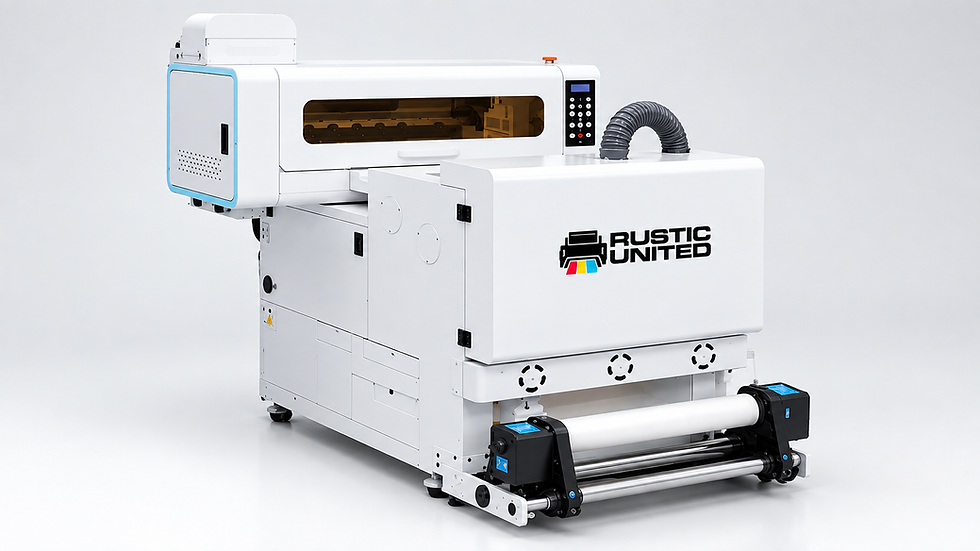
To scale DTF printing operations, fix your DTF finishing process first. Powdering, curing, cutting, and pressing set your real output limit, not your printer speed. Standardize these four steps, add the right equipment, and you raise throughput without buying another printer.
This guide shows where a DTF production workflow stalls, how to fix each stage, and how to build a finishing line that grows with your orders. Alpha Print Supply offers the equipment and consumables that power that line.
Why Finishing Becomes Your Biggest Bottleneck
A fast printer creates a false sense of capacity. Your printer may output a DTF gang sheet in minutes. Every sheet still needs powder, curing, trimming, and pressing. People handle most of those steps.
As volume climbs, the heat press often becomes the bottleneck. If your printer runs all day but curing lags, your bottleneck is finishing. Curing on a press also ties up operator time and blocks the press for other work.
Signs Your Finishing Line Is the Problem
Printed sheets stack up waiting to be cured or cut.
Your press sits busy curing while garments wait.
Operators work overtime while the printer idles.
Reprints rise from peeling or weak adhesion.
This table maps the four stages and where each one stalls.
Finishing Stage | Typical Setting | Where It Stalls | Scaling Fix |
Powder application | Even coat on wet ink | Hand shaking, uneven coverage | Powder shaker |
Powder curing | Oven or hover press, per powder spec | Press tied up, uneven melt | Curing oven |
Cutting and trimming | One cut per sheet or design | Hand trimming lags printer | Cutter or trimmer |
Heat press application | Per film and powder makers' settings | Timing and pressure drift | Automatic or semi-automatic press |
5 Finishing Problems That Cap Your Output
1. Uneven powder coverage: Hand shaking leaves bare spots and clumps that peel after washing.
Fix: Use an automatic powder shaker that coats the film and clears excess in one pass. Explore the powder shakers at Alpha Print Supply and match one to your printer width.
2. Guesswork curing: Operators cure by eye, so sheets come out undercured or overcured. Heavy ink coverage needs longer than light designs, so test both.
Fix: Run a test sheet for each powder and film pair. Log the time and temperature that work, then lock them in. Pair a consistent DTF transfer powder with a hot peel PET film so every roll behaves the same.
3. Curing on your heat press: Hover curing blocks the press. If you cure 100 sheets at 90 seconds each, you lose 2.5 hours of press time.
Fix: Move curing to a dedicated oven. Batch several sheets per cycle, and your press returns to garment work.
4. Hand trimming: Scissors and rotary cutters cannot match printer output, so finished sheets pile up.
Fix: Space designs evenly in your gang sheet layout, then cut with a dedicated tool. Automated cutting systems now exist to keep pace with fast printers. Browse the cutters and trimmers at Alpha Print Supply to find your fit.
5. Inconsistent pressing: Presses drift from their set temperature. A press that runs cooler than its display shows can cause edge peeling.
Fix: Check platen temperature weekly with a surface thermometer. Press at the temperature, time and pressure your film and powder makers specify. Automation lets shops raise output without matching increases in operators.

Build a Finishing Workflow That Scales
Arrange stations in the order the work flows: print, powder, cure, cut, press, and pack. This layout reduces walking and protects finished sheets from damage.
Control Humidity and Storage
Moisture cakes powder and film. Keep storage cool and dry, within the film and powder manufacturers' storage conditions. Seal containers and rotate stock first in, first out to prevent moisture caking in DTF film and powder.
Standardize Your Consumables
Use one film, one powder, and one ink set for each job type. Fewer variables mean fewer test runs and fewer reprints. Uniform film thickness and low curl also help sheets move smoothly through cutters and presses.
Add Automation Where It Pays
Automation protects consistency as volume grows. Automated cutting delivers uniform cuts and reduces manual handling. Automated pressing removes timing variation between operators. Start where labor hours run highest, because that is where automation repays you fastest.
Know When to Upgrade
Use these triggers as a starting point, then adjust to your shop.
Signal | Threshold | Upgrade |
Hover curing time per day | More than 2 hours | Curing oven |
Sheets waiting to trim | Backlog at end of shift | Cutter or trimmer |
Reprints from adhesion failure | Rising two weeks in a row | Press calibration or new press |
Track minutes per sheet at each stage every week. Fix the stage with the highest number first, then measure again, because the bottleneck moves. Buying equipment out of order wastes money.
Finish Faster, Grow Bigger: Turn Finishing Into Your Edge
Your printer earns nothing until a garment ships. Audit your four finishing stages this week. Fix the slowest one first, then measure again. Alpha Print Supply in Kansas City gives you expert support and the right equipment to plan each upgrade.
Browse our complete collection of DTF printers and premium consumables to keep your business printing efficiently and delivering exceptional results.
Frequently Asked Questions
Why does finishing limit DTF production?
Printers run fast, but powdering, curing, trimming, and pressing need time and handling. Each step adds minutes per sheet. When printer output outpaces your slowest finishing step, sheets queue up and turnaround slows. Fixing that step lifts your whole line.
How long does it take to cure DTF powder?
It depends on the powder, ink coverage, the curing method and its temperature, so follow your powder maker's spec and test first. Ovens and automatic shakers typically handle curing without tying up your heat press.
Do you need a curing oven to scale DTF printing?
You can start with a hover cure on a heat press. That method works at low volume. Once curing takes more than about 2 hours of press time daily, an oven frees your press and cures several sheets per cycle. Buy one only after your data shows the need.
What heat press settings work for DTF transfers?
It depends on the film, powder and garment. Cotton often needs more heat, and polyester needs less. Always follow your film maker's instructions and test on a spare garment. Verify your platen temperature to confirm the display matches reality.
Which finishing step should you automate first? Automate the step with the longest queue. Track minutes per sheet at each stage to find it. In many growing shops, that is curing or trimming, and fixing it first lifts your entire output.

Comments