
The Hidden Cost of Cheap DTF Consumables (How To Evaluate Before You Buy)

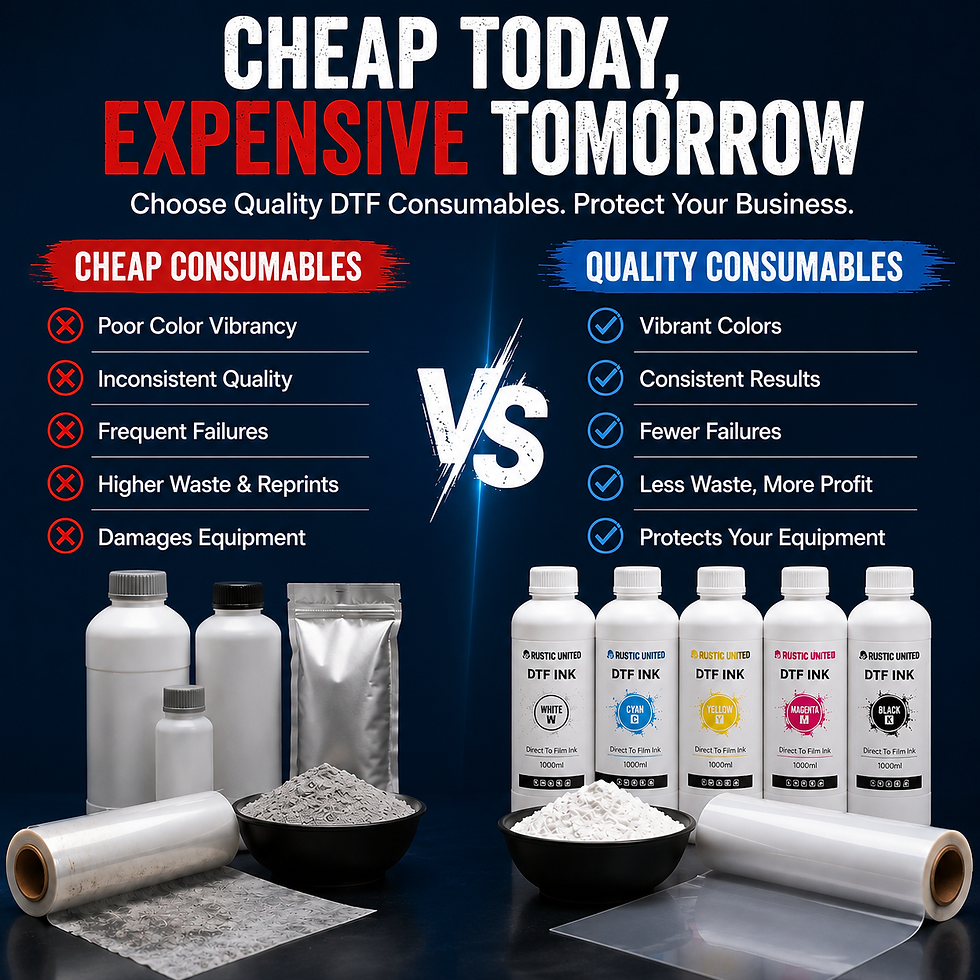
Cheap DTF consumables cost you more than they save. Low-price DTF films, DTF inks, and DTF powders cause cracking, poor wash durability, clogged printheads, and wasted garments. The real cost shows up in reprints, returned orders, damaged equipment, and lost customers. This blog breaks down exactly where that hidden cost comes from and how to spot quality DTF consumables before you buy.
If you run a DTF printing business, your consumables are not a place to cut corners. You will see why below, with real numbers, common failure points, and practical steps to protect your print quality and your bottom line.
Why "Cheap" DTF Consumables Rarely Save You Money
Budget consumables look attractive on a price sheet. The math changes once you factor in failed prints, customer complaints, and printer repairs.
A cracked transfer on a $25 shirt does not just cost you the blank. You lose the ink, the film, the powder, your labor time, and often the customer relationship. Run that math across 50 or 100 failed transfers a month, and a "cheap" film stops looking cheap at all.
The Real Cost Breakdown
Here is where the hidden expenses typically show up:
Reprint costs: Every failed transfer means you reprint the design, using more ink and film for the same order.
Wasted garments: Blanks damaged during a bad press cannot be reused, and that cost comes straight out of your margin.
Printhead damage: Low-grade inks with poor particle consistency clog nozzles and shorten printhead life.
Customer returns: Cracked or peeling transfers after one wash create refund requests and damage your reputation.
Downtime: Cleaning cycles and printhead troubleshooting pull your printer offline during production hours.
How Cheap DTF Films Fail You
Your DTF film is the foundation of every transfer. Thin or inconsistent film stock causes ink bleed, poor powder adhesion, and uneven release during pressing.
Low-quality films often use inconsistent coating thickness. That means some sections of your roll absorb ink properly while others do not, so you get patchy color and soft detail loss on fine text or line art.
What Quality Film Should Deliver
A dependable DTF PET film should give you:
Consistent coating across the entire roll, not just the first few feet
Clean powder release without excess residue
Stable performance across humidity and temperature changes
Smooth peel with minimal cracking on flexible or stretch fabrics
If your film is inconsistent, you will notice it fastest on detailed designs, gradients, and small text where ink absorption problems become visible immediately.
The Problem With Low-Grade DTF Inks
DTF inks determine your color accuracy, opacity, and wash durability. Cheap ink formulations use lower pigment concentration and inconsistent particle size, which means duller colors and reduced coverage on dark garments. Poor ink also breaks down faster under heat during the curing and pressing stage. That degradation is what leads to fading and cracking after just a few wash cycles, sometimes within the first five to ten washes.
Inconsistent viscosity is another common issue. Ink that is too thin soaks through the film unevenly, and ink that is too thick clogs printheads and dries inside nozzles between print jobs. Both problems increase your maintenance costs over time.
Signs Your Ink Is Costing You More Than It Saves
Watch for these warning signs:
Colors look washed out compared to your design file
White ink layers require multiple passes for full opacity
Nozzle checks show missing lines more frequently
Prints crack or fade after minimal washing
Why Powder Quality Matters More Than You Think
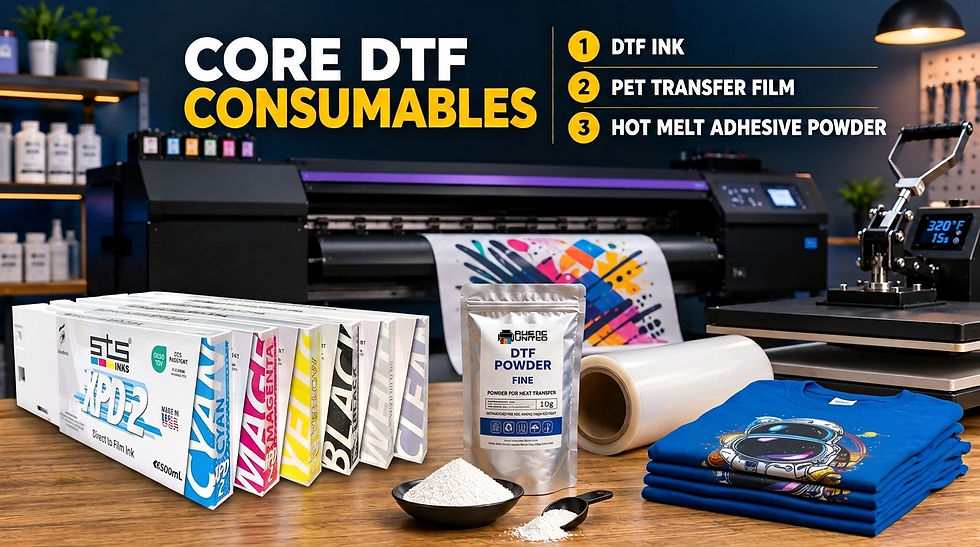
DTF powder binds your ink to the transfer film and creates the bond that holds up in the wash. Cheap powders often have inconsistent particle size, which causes uneven melting during curing.
When powder melts unevenly, you get stiff patches, cracking along the design edges, and reduced elasticity on stretch fabrics like athletic wear. A quality hot melt powder should melt evenly at your standard curing temperature and create a flexible, durable bond without excess stiffness.
Particle size also affects how much powder you use per print. Inconsistent powder often requires heavier application to get full coverage, which means you burn through your stock faster and pay more per finished transfer even though the unit price looked lower.
How to Evaluate DTF Consumables Before You Buy
Price per roll or per liter tells you almost nothing on its own. Compare cost per finished transfer instead. That number accounts for waste, reprints, and coverage rate, and it gives you a real picture of what you are spending. Before switching suppliers or trying a new consumable line, run a small test batch. Press it, wash it five to ten times, and check for cracking, fading, and peeling. A supplier confident in their product will not hesitate to support this kind of test.
Alpha Print Supply works with businesses across Missouri and beyond to source consumables that hold up under real production conditions, not just on a spec sheet. As the authorized Mimaki dealer in the region, the team can help you match films, inks, and powders to your specific printer and workload, so you are not guessing which combination actually performs.
Questions to Ask Any Supplier
What is the recommended cure temperature and time for this powder?
What wash durability testing has this ink gone through?
Is the film coating consistent across the full roll length?
Can you provide a sample for a test run before a bulk order?
Final Thoughts: Protect Your Margins, Not Just Your Budget
Cheap DTF consumables create a cycle of reprints, wasted materials, and unhappy customers that costs far more than the savings on your invoice. Quality DTF films, inks, and powders protect your printer, your production time, and your reputation with every order you fill.
Ready to stop losing money on consumables that fail under real conditions? Alpha Print Supply can help you find the right films, inks, and powders for your setup, backed by real support from a team that understands DTF production. Reach out today to talk through your production needs and get supplies that actually hold up.
Frequently Asked Questions
How much more do quality DTF consumables typically cost? Quality consumables usually run 10 to 25 percent higher per unit than budget options. That difference is often recovered within the first month through fewer reprints and less wasted material, especially on higher volume production.
How can I tell if my DTF ink is causing print failures? Check for dull colors, weak opacity on dark garments, and frequent clogged nozzles during your daily nozzle checks. If prints crack or fade within the first ten washes, the ink formulation is likely the cause rather than your pressing technique.
Does cheap DTF film really affect wash durability? Yes. Inconsistent film coating leads to uneven ink absorption, which weakens the bond between the ink, powder, and garment fibers. That weaker bond is a major reason transfers crack or peel after only a few washes.
What is the best way to test a new DTF consumable before switching? Run a small batch through your normal production process, press it onto your typical fabric types, and wash the samples five to ten times. Check for cracking, color fade, and edge lifting before committing to a full order.
Can low-quality powder damage my printer or press? Powder itself does not usually damage the printer, but inconsistent particle size can affect curing results and create excess residue during pressing. Over time, that residue buildup can affect your press platen and require more frequent cleaning.

Comments