
How to Start a T-Shirt Printing Business with DTF: The Complete Guide
Updated: 2 hours ago

Starting a DTF t-shirt printing business is one of the fastest and most cost-effective ways to enter the custom apparel industry in 2026. DTF printing (Direct-to-Film) allows you to print high-quality designs on almost any fabric with minimal setup, making it ideal for beginners and scaling entrepreneurs alike.
This guide breaks down everything, from setup and costs to profit margins and growth strategy, based on real-world experience and insights. With Alpha Print Supply, a trusted provider of DTF printers, inks, and supplies, you can build a reliable, scalable printing business with confidence.
Why DTF Is the Best Choice for Starting a T-Shirt Printing Business in 2026
What Is DTF Printing?
DTF printing is a process where designs are printed onto a special film, coated with adhesive powder, cured, and then heat-pressed onto fabric. Unlike DTG printing or sublimation printing, DTF doesn’t require fabric pretreatment or polyester-only garments.
Key Advantages Over Screen Printing, DTG, and Sublimation
DTF stands out because it combines flexibility with scalability:
Works on cotton, polyester, blends, and dark fabrics
No minimum order requirements
Lower setup cost than screen printing
More consistent output than DTG printers
Here is how the three most common methods compare for a new shop:
Feature | DTF Printing | Screen Printing | DTG (Direct-to-Garment) |
Setup Time | Minimal | High (Screens/Emulsion) | Moderate |
Fabric Versatility | High (Cotton, Poly, Blends) | High | Limited (Mostly Cotton) |
Color Complexity | Unlimited (Full Color) | Limited by Screens | Unlimited |
Durability | Excellent with proper curing | Excellent | Good |
Minimum Order | 1 Piece | Usually 12-24+ | 1 Piece |
Who Should Start a DTF T-Shirt Business?
A DTF t-shirt business is ideal for small print shops, home-based entrepreneurs, apparel brands, and bulk order suppliers. If your goal is fast turnaround and low minimums without complex setups, DTF is the most practical entry point.
What You Need to Start a DTF T-Shirt Printing Business
Essential Equipment (DTF Printer, Heat Press, Curing Setup)
To start a DTF printing business, you need three core components:
A reliable DTF printer
A consistent heat press
A curing solution (oven or heat press method)
Alpha Print Supply offers DTF printer bundles and complete systems for beginners and growing businesses. Ask our team which setup fits your volume before you buy.
If you are choosing a dedicated production printer, compare the roll-fed models in our DTF printer range, including the Mimaki TxF300-75 for shops planning higher volume. (Mimaki's first DTF printer, the TxF150-75, is not currently offered in our store.) For powder application, an automated 24" powder shaker gives a more even adhesive coat than shaking by hand.
Consumables (Films, Inks, Adhesive Powder)
Your output quality depends heavily on consumables. You’ll need:
High-quality DTF transfer film
Durable DTF inks
Strong adhesive powder
Using low-quality supplies often leads to cracking, fading, or poor adhesion, directly affecting customer retention.
Workspace Setup & Basic Requirements
A small, well-ventilated workspace with stable electricity is enough to begin. You don’t need a large facility, many successful businesses start from home setups.
Recommended Starter Setup (Beginner vs Growth Setup)
A beginner setup focuses on affordability and low volume, while a growth setup prioritizes speed and bulk production. Investing in scalable equipment early, like solutions from Alpha Print Supply, helps avoid frequent upgrades.
How DTF Printing Works: Step-by-Step Process

1. Designing Your Artwork
High-resolution designs (300 DPI) with transparent backgrounds ensure sharp prints. Proper color profiling is essential for accuracy.
Your RIP software also generates the white underbase, the layer of white ink printed behind the colors so they stay bright on dark fabrics.
2. Printing on Film & Applying Adhesive Powder
The design is printed onto film using a DTF printer, then coated evenly with adhesive powder. This step directly impacts durability.
3. Curing and Heat Press
The powdered design is cured using heat, then transferred onto fabric using a heat press. Cure and press at the temperature, time and pressure your film and powder makers specify.
After peeling, many shops add a short post-press to set the design into the fibers. Follow your film manufacturer's peel and post-press settings.
4. Quality Check & Final Output
Inspect for alignment, color vibrancy, and adhesion. A consistent quality check process builds long-term brand trust.
Cost Breakdown
Initial Investment (Equipment & Setup)
Starting a DTF t-shirt printing business requires investing in the right equipment, not just the cheapest options. Rather than rely on generic market price ranges, build your budget line by line from current quotes. Where we list Alpha Print Supply prices, they are live store prices at the time of writing; freight is quoted separately. Contact APS for current pricing.
Entry-Level Setup (Low-Volume / Beginner)
This setup is ideal for home-based businesses or testing the market.
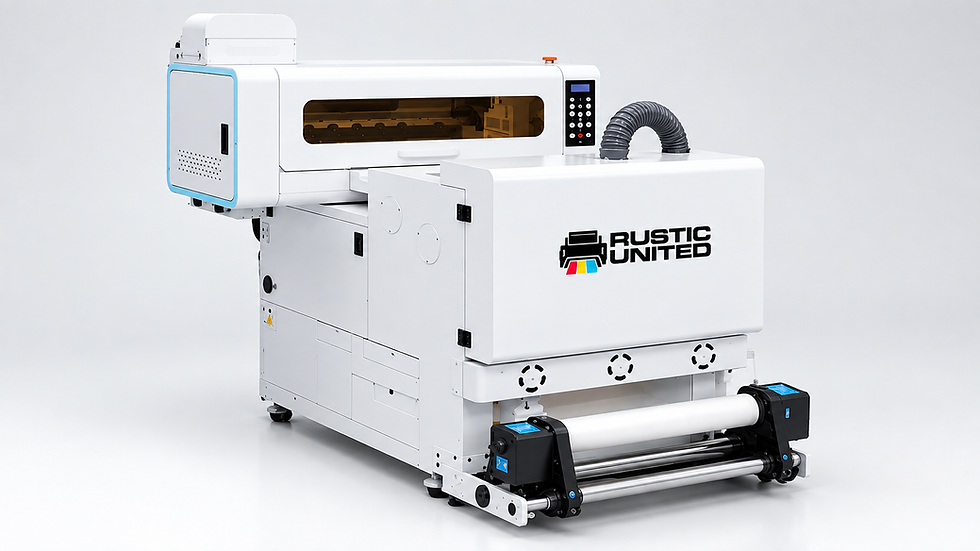
DTF printer: a compact roll-fed model, such as our 12-inch DTF printer ($7,155 at the time of writing) or the Rustic United 16.5" all-in-one with powder shaker (see current pricing on its product page)
Heat press: a manual clamshell press is a common starting point; get current quotes
Curing setup: a curing oven, or the heat press method where your powder maker allows it
RIP software: for color management and the white underbase
Starter consumables: ink, film and powder, priced from our consumables range
Total: printer + heat press + curing + RIP software + consumables + freight. Add up the current quote for each line.
Entry-level printers may seem attractive due to their lower cost, but they are often slower and offer smaller print areas. That’s why many small business owners prefer mid-range printers for better speed and more consistent color output.
Mid-Level Setup (Growth / Small Production)
This setup is designed for consistent orders and scaling operations.
DTF printer: a 24-inch roll-fed model, such as our 24-inch DTF printer with 4 Epson I3200 printheads ($16,995 at the time of writing), or the Mimaki TxF300-75 (see current pricing on its product page)
Pneumatic or upgraded heat press: get current quotes
Powder shaker + curing: for example, our 24" powder shaker with heat chamber ($5,000 at the time of writing); see all powder shakers
Air filtration / ventilation system: see our air filtration systems; contact APS for current pricing
Bulk consumables: ink, film and powder in the volumes your orders need
Total: add up the current quote for each line, including freight.
Cost Per Print & Profit Margins
Cost per print depends on design size, ink coverage, and what you pay for film, ink, and powder, so calculate it from your own consumable prices: add the ink, film and powder used per transfer, then a share of labor, misprints and maintenance. Set your selling price from that number and your local market, and subtract blank garments and overhead before you judge profitability.
Hidden Costs Beginners Overlook
Common overlooked expenses include maintenance, wasted prints, electricity, and design software. Planning for these avoids early cash flow issues.
Break-Even: How to Estimate Yours
How fast you break even depends on your equipment cost, pricing, and order volume. A simple estimate: break-even months = total setup cost ÷ (orders per month × profit per order). Shops with steady daily orders and bulk B2B work recover their investment faster than shops relying on occasional one-off sales, so build your plan on realistic order numbers rather than best-case ones.
Why Choosing the Right Supplier Matters: Alpha Print Supply Advantage
Your profitability doesn’t just depend on costs, it depends on consistency, reliability, and support.
With Alpha Print Supply, you get more than just equipment:
Pre-configured DTF printer bundles (no trial-and-error setup)
Optimized ink + film compatibility for better print durability
Service and guidance from our technicians when something goes wrong
Expert support to help you avoid costly beginner mistakes
Instead of experimenting with mismatched components, investing in a complete solution from Alpha Print Supply helps you:
Start faster
Reduce waste
Maintain consistent print quality
Scale confidently without frequent upgrades
How to Get Your First Customers & Grow Fast
Best Niches for T-Shirt Printing (Local & Online)
Focus on niches with recurring demand such as:
Local businesses and uniforms
Events and sports teams
Trend-based designs for online stores
Pricing Strategy for Maximum Profit
Avoid underpricing. Position your brand based on quality and turnaround time, not just cost. Offer bundle pricing for bulk orders.
Selling Channels (Etsy, Shopify, Local B2B Orders)
Start with platforms like Etsy or Shopify while simultaneously targeting local clients. B2B orders often provide higher volume and consistent income.
The Gang Sheet Model
Many DTF shops also sell gang sheets: lengths of film filled with multiple designs, sold as ready-to-press transfers to crafters and small brands who own a heat press but not a printer. It is a low-overhead way to keep your printer busy between garment orders.
Marketing Strategy (Social Media + Local Outreach)
Use social proof, videos, before/after prints, and customer testimonials. Local outreach (schools, gyms, businesses) drives faster initial traction than online ads alone.
Final Thoughts: Turn DTF Printing into a Scalable Business
Starting a DTF t-shirt printing business is not just about equipment, it’s about building a system that delivers consistent quality and profit. With the right setup, clear pricing, and focused marketing, you can scale faster than traditional printing methods.
Alpha Print Supply provides the tools, expertise, and support needed to launch and grow with confidence. If you’re serious about building a profitable printing business, now is the time to invest in the right foundation and start producing results.
Frequently Asked Questions
1. Is DTF printing good for beginners?
Yes, DTF printing is beginner-friendly due to its simple process and minimal setup requirements. With the right equipment, you can start producing high-quality prints quickly.
2. How long do DTF prints last on t-shirts?
High-quality DTF prints hold up well to repeated washing when the ink, film and powder are matched and cured and pressed as their manufacturers specify. Results vary by materials and settings, so run your own wash tests.
3. Can I start a DTF business from home?
Yes, you can run a DTF printing business from home with a small, well-ventilated workspace. Many beginners start this way before scaling operations.
4. What is the profit margin in a DTF t-shirt business?
Margins depend on your pricing, blank garment costs, labor, and overhead. The print itself can carry a high margin, but calculate profit after blanks and waste. Bulk orders and efficient production improve profitability.
5. Do I need design skills to start? Basic design knowledge helps, but you can also use ready-made designs or outsource work. Your primary focus should be print quality and customer satisfaction.


Comments