
Is DTF Printing Profitable? The Real Numbers Behind the Business
Updated: 8 hours ago

Yes, DTF printing can be profitable, but whether it's profitable for you depends on your own numbers: your equipment, your consumables, your waste, your labor and your prices. There's no honest universal margin figure. What you can do is calculate your real cost per print and price from it.
This guide shows you how to work out what one DTF transfer costs you, how DTF compares with screen printing, how to estimate your break-even point, and where profit usually gets lost.
What Does It Actually Cost to Print One DTF Transfer?
Your cost per transfer comes from a handful of line items. Gather these inputs from your own suppliers and test runs:
Ink: the cost of a bottle divided by what it actually prints. Many RIPs estimate ink use per job; otherwise, track how much ink a measured batch of prints uses. White underbase is often the biggest ink cost, so measure it separately.
Transfer film: the cost per roll divided by the roll's length and width gives your cost per square foot. Multiply by the area each design uses, including the space you lose between designs.
Powder: the cost per bag divided by how many transfers a bag actually covers in your shaker or by hand.
Labor: minutes per transfer (printing, powdering, curing, trimming, pressing, packing) multiplied by your hourly cost.
Blank garment: if you sell finished shirts, add the blank at the quantity you buy.
Overhead per unit: a share of equipment cost, maintenance, electricity, software and rent, spread over the units you realistically produce.
Add these up for your typical design sizes to get your cost per transfer and per finished shirt.
Why results vary from shop to shop:
Large, white-heavy designs use far more ink than small, light ones
Good nesting on the film roll cuts waste; printing one design at a time increases it
Consumable prices change with quantity and supplier
Reprints from clogs, poor curing or bad film quietly raise the cost of every good print
Labor per piece drops when you batch work and rises with one-off orders
Your DTF supplies quality changes this math directly. Film that wastes powder or ink that clogs printheads adds costs that never show up on a price tag but show up in your margin every week.
DTF Printing vs. Screen Printing: Which One Makes More Money?
Screen printing wins on large runs of the same design. Its per-unit cost drops as quantity rises, because the setup is spread over more pieces. But many shops don't live in that world.
Screen printing carries setup costs for every job: screens, emulsion, exposure and a separate screen for each color. Those costs make small and custom orders hard to price profitably.
DTF printing removes that barrier.
No screens, no burning, no color separations
One file prints any number of colors in a single job
Small orders, even a single shirt, can still be priced profitably
The same transfer works on cotton, polyester and blends without changing equipment
For on-demand orders, personalized gifts and short runs, DTF often produces a better margin per print because there's no setup cost eating into the sale. To find the crossover point for your shop, compare your DTF cost per shirt with a screen printer's quote (or your own screen printing costs) at different order sizes.
How Fast Do DTF Shops Break Even?
Break-even speed depends on what you spend up front and how much profit each sale brings in. Here's how to estimate it:
Total startup cost: printer, powder shaker or curing equipment, heat press, ventilation, software, starting consumables, and freight and installation (for equipment, freight is quoted separately)
Profit per unit: your selling price minus your full cost per shirt from the section above
Units per month: a realistic sales estimate, not a best case
Break-even months = total startup cost divided by (profit per unit multiplied by units per month)
Run it with a low, middle and high sales estimate. If break-even only works at the high estimate, start smaller or line up orders first.

Also budget for maintenance. Ask your dealer for the manufacturer's maintenance schedule and parts that wear, such as wipers, capping parts and dampers, so a profitable machine doesn't turn into an unplanned repair bill.
Where DTF Shops Lose Money (And How to Stop It)
Most profit leaks trace back to three sources: inconsistent supplies, poor maintenance and underpricing.
Low-grade film can take ink unevenly and force reprints. Poor powder can cure inconsistently and crack in the wash. Every reprint costs you material twice and labor twice. Alpha Print Supply stocks consumables such as Rustic United DTF Ink, Ultra Premium Double Matte Hot Peel film and Rustic United fine DTF powder for a consistent workflow.
Underpricing is the second silent killer. Many new shop owners price shirts without accounting for platform fees, packaging or their own labor. Build every cost, including your time, into your price.
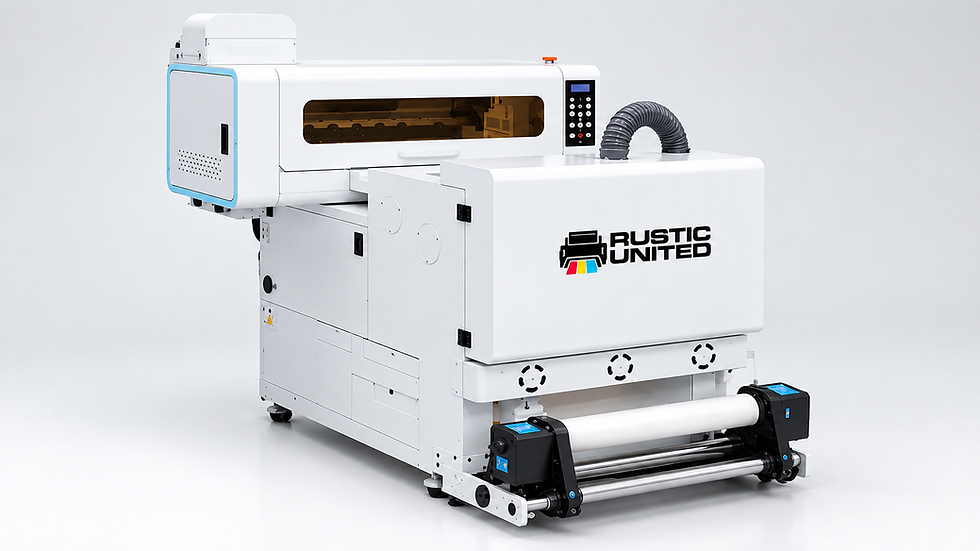
If you're scaling past an entry-level setup, printer choice matters as much as consumables. Alpha Print Supply carries DTF printers from Mimaki, STS and Rustic United, including the Mimaki TxF300-75, the STS XPD-924D and the Rustic United 16.5" All-in-One DTF Printer with Powder Shaker. Contact us for current pricing.
Where the Profit Comes From: Sales Channels That Work
Production efficiency only matters if you can sell what you print. These channels work for many DTF shops:
Etsy and Amazon Handmade: large marketplaces where personalized and custom items are a popular category
TikTok Shop and Instagram: visual, trend-driven platforms where custom products get engagement through demos and behind-the-scenes content
Local pop-ups and markets: no platform fees, and a chance to build repeat local customers
B2B and bulk orders: schools, teams and small businesses order in volume for uniforms and fundraisers
Gang sheets and transfers for other decorators: selling printed transfers to shops that press their own garments
Your own website: slower to build traffic, but gives you full control over pricing and customer data
Spread sales across two or three channels instead of relying on one. Diversifying protects your revenue when a platform changes its fees or algorithm.
Practical Steps to Protect Your DTF Profit Margin
Track your true cost per shirt monthly, including ink, film, powder, labor and reprints
Buy consumables in quantities you'll use within their shelf life, to lower your per-unit cost without waste
Follow your printer manufacturer's maintenance routine for the printhead and white ink circulation
Price every product to include your labor, not just materials
Test new film and ink batches before switching your full workflow
Final Thoughts: Turning DTF Printing Into a Real Profit Engine
DTF printing rewards shops that treat it like a business, not a hobby. Equipment matters, but consumables and cost-tracking discipline matter just as much. Get those right, and healthy margins are realistic, though your numbers depend on your own costs and pricing. Alpha Print Supply supplies the printers, inks, films and powders to run a consistent DTF workflow, and our team can help you choose the right machine and consumables for your volume. Call (816) 608-5273 or email support@alphaprintsupply.com.
Browse our complete collection of DTF printers and consumables.
Frequently Asked Questions
1. How much profit can you make per DTF shirt?
It depends on your selling price and your full cost per shirt: ink, film, powder, blank, labor, overhead and fees. Calculate your cost per shirt with the method above, then subtract it from your price. Your profit improves as you reduce waste and reprints.
2. Is DTF printing more profitable than screen printing?
For small and custom orders, DTF is often more profitable because it has no screens or color separations to set up. Screen printing becomes more cost-effective on large runs of the same design. Compare costs at your typical order sizes to find the crossover.
3. How long does it take to break even on a DTF printer?
Divide your total startup cost by your monthly profit (profit per unit multiplied by units sold per month). Run the calculation with conservative sales numbers. The result varies widely with equipment cost, pricing and volume.
4. What is the biggest hidden cost in DTF printing?
Reprints are a common one: clogged printheads, poor curing and cracked transfers cost you materials and labor twice. Unplanned maintenance is another, so budget for the parts and service your printer's manufacturer recommends.
5. Do I need a commercial printer to be profitable with DTF?
Not necessarily. An entry-level DTF printer can run a profitable small business if your pricing covers your costs. A production printer makes sense once your weekly order volume outgrows a smaller unit. Contact Alpha Print Supply to compare DTF printers for your volume.


Comments