
Signs It's Time to Replace Your DTF Ink Before It Ruins Your Prints

Your DTF ink is showing its age when colors fade, print heads clog often, or the ink separates in the bottle. These warning signs mean your ink has broken down and can no longer deliver sharp, durable prints. This guide walks you through the exact signs to watch for, why they happen, and what to do about them so your DTF printing business keeps producing prints customers actually want to wear.
Ink quality is not a minor detail. It is the difference between a transfer that survives fifty washes and one that cracks after five. Below, you will find the seven clearest signs your ink needs replacing, how to test it before a big run, and how often you should be rotating stock.
How DTF Ink Quality Directly Affects Your Bottom Line
Bad ink does not just hurt print quality. It costs you materials, time, and customer trust. A single failed batch on a 100-shirt order can mean $150 to $300 in wasted film, powder, and labor. Fresh, properly stored DTF ink protects your margins and your reputation. If you are unsure how storage conditions affect usable ink life, see our guide on how long DTF ink lasts and how to store it properly.
Ink quality affects three things every shop owner cares about:
Color accuracy: degraded ink shifts hue and saturation
Print durability: old ink cracks, peels, or fades after washing
Machine health: thickened or separated ink clogs print heads and damages nozzles
7 Signs Your DTF Ink Needs Replacing
1. Faded or Inconsistent Colors
If your white ink prints gray, or your CMYK colors look dull compared to a fresh cartridge, pigment particles have likely settled or degraded. This is one of the most common signs of aging DTF ink, especially with white ink, which separates faster than color ink due to its heavier titanium dioxide content.
2. Frequent Print Head Clogging
Clogs that return within hours of a cleaning cycle point to ink viscosity changes. Old ink thickens as it oxidizes, making it harder to flow smoothly through nozzles. If you are cleaning your print head more than twice a week, treat that as a red flag, not routine maintenance.
3. Ink Separation or Sediment
Shake your ink bottle and check the pour. Fresh ink should flow evenly with no visible clumps. If you see sediment at the bottom or the ink separates into layers, it has broken down chemically and will not reconstitute with shaking alone.
4. Cracking or Poor Wash Durability
A properly cured DTF transfer should survive 50 or more wash cycles without cracking. If your transfers start peeling or cracking after just 10 to 15 washes, the ink's binding agents have likely degraded, weakening adhesion to the film and garment.
5. Unusual Odor or Texture Changes
Fresh DTF ink has a mild, consistent smell. A sharp, sour, or chemical odor signals bacterial growth or chemical breakdown, both of which compromise print adhesion and can damage your printer over time.
6. Ink Past Its Shelf Life
Most DTF inks carry a shelf life of 12 to 18 months unopened, and 3 to 6 months once opened, depending on storage conditions. Check the manufacture date on your bottles. If you cannot recall your last restock, that alone is a signal to inspect your inventory.
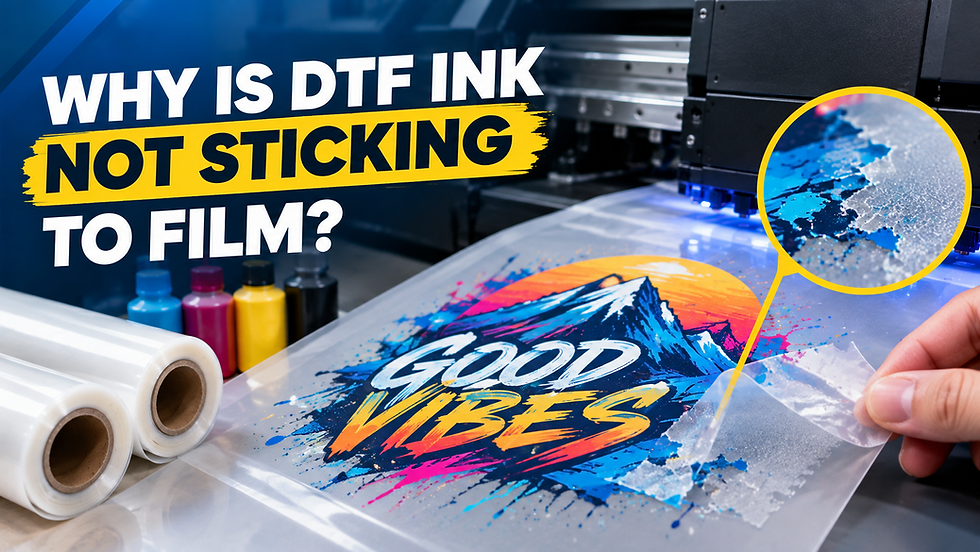
7. Poor Adhesion on Film
If ink beads up or fails to spread evenly across your DTF film, the ink's surface tension has changed. This often happens alongside separation and leads to patchy, uneven prints that no amount of pressing time can fix.

How to Test Your DTF Ink Before a Big Print Run
Before committing to a large order, run a quick test:
Print a small color swatch and check saturation against a known-good reference
Cure and wash-test a sample transfer 10 times
Inspect the print head after 20 minutes of idle time for dried ink buildup
This three-step check takes under 30 minutes and can save you an entire production run.
How Often Should You Replace DTF Ink?
Most shops running daily production should plan to fully rotate their ink stock every 3 to 4 months. Shops printing less frequently, once or twice a week, should check ink condition monthly, since infrequent printing accelerates settling and clogging. Buying in smaller, more frequent batches keeps your ink fresher than stockpiling large quantities you will not use for months.
Choosing the Right Replacement Ink
Not all replacement ink performs the same. Look for DTF ink formulated for consistent particle size, strong wash durability, and compatibility with your specific printer model. Alpha Print Supply carries Rustic United DTF Ink, built for reliable color output and long-lasting wash performance across popular DTF printer models. If you are unsure which formulation fits your setup, comparing your current print volume and printer model against available options makes the decision straightforward.
Fresh Ink, Better Prints: Final Thoughts
Ink is not a set-it-and-forget-it supply. It has a shelf life, storage requirements, and clear warning signs when it starts to fail. Catching these signs early protects your prints, your machine, and your customers' trust in your work. If your current ink is showing any of these seven signs, do not wait for a failed order to force the decision. Alpha Print Supply stocks fresh, tested DTF inks and consumables ready to ship, along with the technical support to help you choose the right formulation for your printer.
Explore Alpha Print Supply's complete range of DTF printers, premium consumables, and expert solutions to build or grow your printing business with confidence.
Frequently Asked Questions
How long does DTF ink last once opened? Opened DTF ink typically lasts 3 to 6 months when stored properly in a cool, dark location. Heat and light exposure shorten this window significantly. Always check the manufacture date and your shop's storage conditions before assuming ink is still usable.
Can I mix old and new DTF ink? Mixing old and new ink is not recommended, since it can introduce inconsistent viscosity and color shifts into your printer system. This mismatch often causes clogging or uneven color output. It is safer to fully empty and clean your ink lines before switching to a new batch.
What causes DTF white ink to separate faster than color ink? White ink contains a higher concentration of titanium dioxide particles, which settle faster than the pigments in color ink. This is why white ink needs more frequent shaking and shorter storage windows. Daily agitation, either manually or through your printer's built-in shaker, slows this process.
Does storage temperature affect DTF ink lifespan? Yes, storage temperature has a major effect on ink lifespan. Ink stored above 86°F degrades faster and separates sooner than ink kept between 59°F and 77°F. Keeping your storage area climate controlled extends usable ink life significantly.
How do I know if clogging is caused by ink or a printer issue? Run a nozzle check after cleaning; if clogs return within a few hours, the ink is the likely cause rather than the printer. Persistent clogging despite fresh ink usually points to a hardware issue instead. Testing with a small amount of new ink quickly isolates the source.
Comments