
What to Look for Before Buying a DTF Printer: A Beginner’s Guide to Making the Right Investment
Updated: 5 hours ago

If you're planning to start a custom apparel business or upgrade your print shop, choosing the right DTF printer is one of the most important decisions you'll make. The best printer isn't necessarily the fastest or the most expensive, it's the one that matches your production goals, budget, and long-term business plans. Before buying a Direct-to-Film (DTF) printer, you should evaluate factors such as print quality, speed, ease of use, maintenance, operating costs, and after-sales support. Understanding these essentials will help you invest in a machine that delivers consistent results and grows with your business.
Why Choosing the Right DTF Printer Matters
The popularity of DTF printing has grown rapidly because it allows businesses to produce vibrant, durable transfers on cotton, polyester, blends, and many other fabrics without complicated pre-treatment. However, not every printer is built for the same type of workload. A beginner starting a home-based business has different needs than an established print shop handling hundreds of orders every week.
Buying a printer without considering your production requirements can lead to unnecessary expenses, slower workflows, and higher maintenance costs. Taking time to compare features before purchasing will save money and improve productivity in the long run.
Key Things to Consider Before Buying a DTF Printer
1. Prioritize Print Quality Over Specifications
The first thing customers notice is the quality of your prints. Sharp details, vibrant colors, smooth gradients, and solid white ink coverage all contribute to professional-looking transfers. Instead of focusing only on technical numbers, ask yourself whether the DTF printer can consistently produce the quality your customers expect.
For beginners, investing in dependable print quality is often more valuable than choosing a machine simply because it advertises the highest specifications.
2. Choose a Printing Speed That Matches Your Workload
Printing speed directly affects how many customer orders you can complete each day. If you're just launching your business, an entry-level printer with moderate production capacity is usually sufficient. However, businesses expecting bulk orders should consider equipment designed for continuous production without sacrificing quality.
Remember that printing speed is only one part of productivity. Fast warm-up times, efficient workflow, and reliable performance throughout the day also contribute to quicker order fulfillment.
3. Consider Ease of Use
Many beginners assume DTF printing requires advanced technical knowledge. In reality, modern printers are much easier to operate than earlier generations.
Look for equipment with:
User-friendly software
Simple file import options
Easy print settings
Clear training resources
Responsive technical support
A printer that's easy to learn allows you to spend more time serving customers and less time troubleshooting.
4. Evaluate Build Quality and Reliability
A DTF printer is a business investment, not just another office machine.
Strong construction, quality components, and reliable engineering help reduce unexpected downtime and repair costs. Machines designed for continuous operation generally provide better long-term value than lower-quality alternatives that require frequent maintenance.
Reading customer reviews, checking manufacturer reputation, and purchasing from an experienced supplier can provide confidence before making your investment.
5. Understand the True Cost of Ownership
Many first-time buyers focus only on the purchase price. However, the long-term operating cost often has a greater impact on profitability. When comparing printers, consider expenses such as:
Replacement parts
Electricity consumption
Routine maintenance
A printer with a slightly higher purchase price may actually cost less to operate over several years because it uses supplies efficiently and requires fewer repairs.
6. Maintenance Should Be Simple and Consistent
Every DTF printer requires routine maintenance to deliver reliable performance. Tasks such as printhead cleaning, nozzle checks, and ink circulation help prevent clogging and maintain print quality. Choosing a printer with automated maintenance features can significantly reduce manual work while extending the life of critical components.
Which DTF Printer Is Right for Your Business?
Choosing the right printer depends on your production volume, budget, and future business goals. At Alpha Print Supply, beginners and growing businesses can choose from professional solutions designed for different stages of business growth.
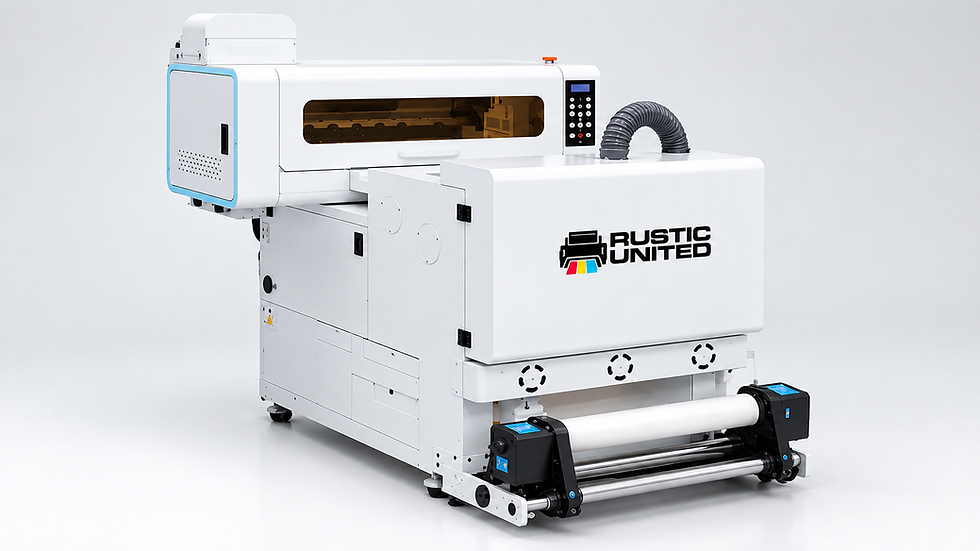
1. Rustic United All-in-One DTF Printer with Powder Shaker
The 16.5 Inch All-in-One DTF Printer is an excellent entry point for entrepreneurs launching a DTF printing business. Its integrated powder shaker streamlines production, reduces manual handling, and helps beginners achieve consistent transfer quality with a compact setup. It is ideal for startups, home-based businesses, and small custom apparel brands looking for an affordable way to enter the market.
2. 24-Inch Roll-Fed DTF Printers
For businesses ready to move beyond entry-level production, a 24-inch roll-fed printer is the usual next step. Alpha Print Supply carries several, including the 24-inch DTF Printer with 4 Epson I3200 Printheads; compare all current models in our DTF printer range. Mimaki's TxF150-75, the company's first DTF printer, has been a common choice in this class, but it is not currently offered in our store.
3. Mimaki TxF300-75 DTF Printer
For businesses handling larger production volumes, the Mimaki TxF300-75 DTF Printer offers faster output and industrial-grade reliability. Its higher productivity makes it suitable for established print shops, contract printers, and businesses planning to scale their operations without compromising print consistency or efficiency.
Common Mistakes to Avoid When Buying a DTF Printer
Avoid these common mistakes to save money, reduce downtime, and make a smarter investment:
Choosing a printer based only on price instead of considering long-term performance and operating costs.
Ignoring future business growth by buying a machine that cannot handle increasing order volumes.
Overlooking warranty and technical support, which are essential for minimizing downtime and resolving issues quickly.
Using low-quality consumables, as poor DTF ink, PET film, and DTF powder can reduce print quality regardless of the printer.
Assuming DTF printers are maintenance-free, when regular cleaning and routine upkeep are necessary for consistent performance.
Final Thoughts: Buy for Long-Term Success, Not Just Today's Needs
Purchasing a DTF printer is more than buying a piece of equipment, it's investing in the future of your business. The right machine should deliver excellent print quality, reliable performance, manageable operating costs, and the flexibility to grow as your customer base expands. Before making a decision, think about your production goals, expected order volume, available budget, and the level of support you'll need.
Whether you're starting your first DTF printing business or upgrading an existing operation, Alpha Print Supply offers professional solutions backed by industry expertise and reliable customer support.
Explore our complete range of DTF printers and premium consumables to build or grow your printing business with confidence.
Frequently Asked Questions
1. What is the most important factor to consider when buying a DTF printer?
The most important factor is choosing a printer that aligns with your business needs. While print quality is critical, you should also evaluate production speed, maintenance requirements, operating costs, and available support. A machine that fits your workflow will provide better long-term value than one chosen solely for its specifications.
2. Is DTF printing suitable for beginners?
Yes, DTF printing is one of the most beginner-friendly apparel decoration methods available today. Modern printers come with user-friendly software and simplified workflows. With basic training and regular maintenance, most new users can quickly learn how to produce professional-quality transfers.
3. How much maintenance does a DTF printer require?
All DTF printers require routine maintenance to keep printheads and ink systems functioning properly. Typical tasks include nozzle checks, printhead cleaning, and monitoring ink circulation. Consistent maintenance helps prevent clogs, improves print quality, and extends the lifespan of the equipment.
4. Should I choose an entry-level or professional DTF printer?
The answer depends on your production goals. Entry-level machines are ideal for startups, home-based businesses, and low-volume production. Professional printers are better suited for growing businesses that require faster output, greater reliability, and the ability to handle larger order volumes consistently.
5. How long does a DTF printer last?
The lifespan of a DTF printer depends on build quality, maintenance practices, and usage levels. A well-maintained machine from a reputable manufacturer can provide many years of reliable service. Regular maintenance and the use of quality consumables are key factors in maximizing equipment longevity.


Comments