
Why Is DTF White Ink Separating? The Real Causes and Fixes

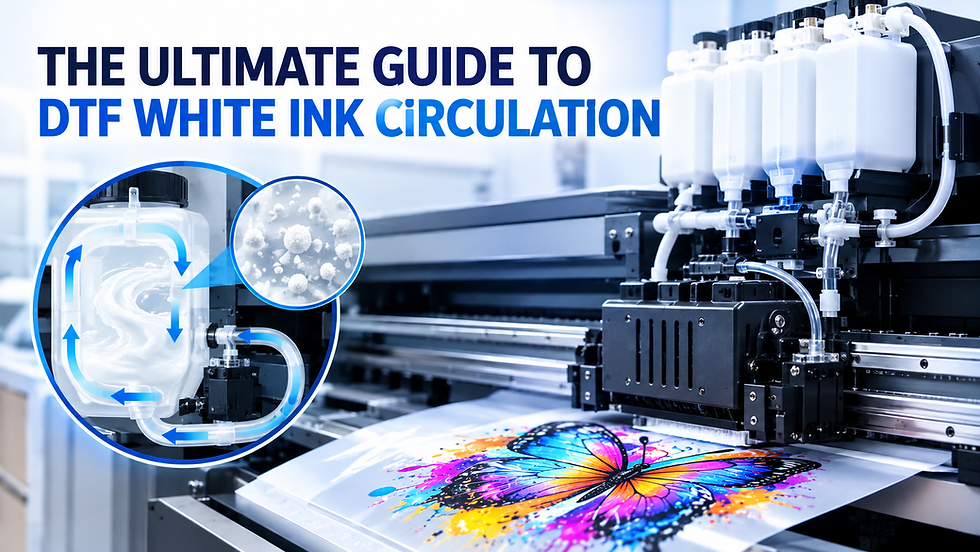
DTF white ink separates because titanium dioxide, the pigment that gives it opacity, is far denser than the color pigments in your cyan, magenta, yellow, and black channels. Left undisturbed for even a few hours, those heavy particles sink toward the bottom of the ink bottle, feed lines, and printhead. The result is banding, patchy coverage, weak opacity on dark garments, and eventually a clogged nozzle.
This guide breaks down exactly why DTF white ink separation happens, how to diagnose how bad your case is, the fastest way to fix it, and the daily habits that stop it from coming back. You'll also find practical product guidance from Alpha Print Supply to help you choose ink that resists this problem in the first place.
What Causes DTF White Ink to Separate?
Every DTF ink is pigment based, but white ink carries a much heavier load. It uses titanium dioxide (TiO₂), the same compound used in white paint, to create the opaque base layer that lets colors pop on black and dark colored shirts. That density difference between white pigment and color pigment is the entire problem behind white ink sedimentation.
Property | White Ink (TiO₂) | Color Ink (CMYK) |
Particle density | ~4.0-4.2 g/cm³ | ~1.1-1.5 g/cm³ |
Settling onset | 2-4 hours idle | Days to weeks idle |
Particle size | Larger, blocks nozzles faster | Smaller, flows freely |
Circulation needed | Yes, daily minimum | Not required |
Viscosity | Thicker, more line resistance | Standard flow |
Where Sedimentation Happens First
Settling moves through your system in a predictable order:
The ink bottle or bulk tank, where the heaviest particles drop out first
The feed lines, where slow-moving ink lets particles build up along the tubing walls
The damper, a low-flow reservoir just above the printhead and a common sediment trap
The printhead nozzles themselves, the last and most costly place for buildup to reach
Other Contributors Beyond TiO₂ Settling
TiO₂ settling is the leading cause, but not the only one. Temperature swings, humidity outside the 40 to 60 percent range, and long-distance shipping without agitation all accelerate ink separation. Low-quality ink formulated without proper dispersing agents will separate faster than a well-engineered ink under identical storage conditions. If separation shows up soon after opening a new bottle, the ink's formulation, not your maintenance routine, is likely the real issue.
How Do You Know If DTF White Ink Has Separated?
Run a nozzle check before assuming anything. If your color channels print cleanly but the white channel shows gaps, banding, or faded opacity, white ink separation is your most likely culprit.
A thick white layer sitting at the bottom of the bottle with clear liquid on top
Ink that pours unevenly or clumps when tilted
Gray or brown discoloration inside the damper
Streaking or missing nozzle rows that affect only the white layer, not CMYK
Match the severity to the fix. A mismatch wastes time and product:
Severity | Nozzle check | Typical fix | Time needed |
Minor | Under 10% missing | 2-3 automatic cleaning cycles | 5-10 min |
Moderate | 10-50% missing | Manual flush + damper purge | 20-30 min |
Severe | 50%+ missing or zero output | Full soak method | 30 min - 2 hrs |
How Do You Fix DTF White Ink Separation?
Step 1: Shake and Circulate Before Every Session
Shake the white ink bottle for a full 60 to 90 seconds before loading it. This alone resuspends most overnight settling. If your printer has a white ink circulation system, trigger a manual cycle and confirm ink is visibly moving through the transparent tubing. No movement usually means a pump issue that needs servicing before you print anything.
Step 2: Purge the Damper
The damper traps sediment faster than any other component because it sits in a low-flow zone. Using a small syringe, draw 2 to 3 ml of ink from the inlet port slowly. Thick or gray ink means significant buildup and a likely replacement. Clear white ink with no particles means the purge worked. Never pull the plunger quickly; forcing it can collapse the damper or pull air into the nozzle channels.
Step 3: Clean the Wiper Blade and Capping Station
A wiper blade caked with dried ink drags residue across the nozzle plate instead of clearing it. Wipe it in one direction, base to tip, using a cleaning solution formulated to dissolve dried pigment, not water. The capping station foam should stay damp, never dry or crusted. A dry cap lets the printhead dry out between sessions and speeds up clogging overnight.
Step 4: Soak for Severe Clogs
When cleaning cycles and flushing haven't restored output, a longer soak is next. Saturate a lint-free pad with a cleaning solution and rest the nozzle plate against it. Moderate clogs typically need 15 to 30 minutes; severe clogs with 50 percent or more missing can take 1 to 2 hours. Flush gently through the damper inlet afterward and run several cleaning cycles before checking nozzles again. If recovery stalls below 70 percent after multiple soak attempts, the printhead may need professional evaluation.

How Do You Prevent DTF White Ink Separation?
Prevention costs minutes. Recovery costs hours, and sometimes a printhead. Build these habits into your daily routine:
Shake and circulate white ink before every print session, without exception
Keep your shop between 68 and 77°F with humidity around 40 to 60 percent
Store unopened ink in a cool, dark space away from direct sunlight
Run circulation daily, even on days you don't print
Flush the white channel and replace it with a maintenance solution if the printer sits idle beyond 48 hours
Choosing the right ink from the start matters just as much as your routine. Alpha Print Supply carries Rustic United DTF Ink and STS Inks XPD2, both formulated with dispersing agents that keep TiO₂ in suspension longer than budget alternatives, reducing how often you need to intervene. If your shop is expanding into hard surface work, Rustic United UV DTF Ink is built to the same stability standard. Pairing stable ink with a printer that includes built-in white ink circulation, like the Mimaki TxF150-75, gives you the strongest defense against sedimentation without adding manual work to your day.
Key Takeaways
TiO₂ pigment is 3 to 4 times denser than color pigment and starts settling within 2 to 4 hours of inactivity
A nozzle check quickly separates minor, moderate, and severe clogs, and each needs a different fix
Shaking, circulating, purging the damper, and cleaning the cap station resolve most cases without a soak
Daily circulation and stable ink formulation prevent separation from becoming a recurring problem
Closing Perspective: Keep Your White Channel Running, Not Guessing
DTF white ink separation is predictable, preventable, and fixable once you understand what's happening inside your ink lines. The pigment doesn't fail; it settles, and settling is manageable with the right routine and the right ink. If your shop keeps fighting the same white channel gaps every Monday morning, it's worth auditing both your maintenance schedule and your ink supplier.
Alpha Print Supply stocks DTF inks, printers with built-in circulation systems, and the full range of consumables your production line depends on. Reach out to our team today to find the ink and equipment combination that keeps your white layer consistent, print after print.
Frequently Asked Questions
Why does my DTF white ink separate so much faster than my color inks?
White ink uses titanium dioxide, a pigment roughly 3 to 4 times denser than the pigments in CMYK inks. That extra weight causes it to sink out of suspension within hours instead of days. Shaking before use and running regular circulation keeps the particles evenly distributed.
Can I still use white ink that has separated in the bottle?
Yes, in most cases, as long as you shake it thoroughly for 60 to 90 seconds until the layers fully reincorporate. If the ink has dried into a solid crust or won't reincorporate after shaking, discard it and open a fresh bottle instead.
How often should I run white ink circulation?
Daily, at minimum, even on days you aren't actively printing. Printers with automatic circulation handle this on a schedule. Without one, trigger a manual cycle at the start and end of every working day to keep pigment suspended.
Does storage temperature really affect white ink separation?
Yes. Extreme heat or cold breaks down the ink's dispersing agents faster, speeding up sedimentation. Keep unopened bottles in a cool, dark space between roughly 68 and 77°F for the most stable shelf life.
Is ink separation the same problem as printhead clogging?
They're related but not identical. Separation is the pigment settling out of suspension; clogging is what happens when that settled pigment dries and blocks the nozzle channels. Catching separation early through shaking and circulation prevents it from progressing into a full clog.


Comments