
Why Do Printers Use More Than CMYK? The Real Benefits of Extended Color Gamut
Quick answer: Standard CMYK printing physically cannot reproduce every color, real-world ink pigments have impurities that cap how saturated a mixed color can get, especially bright oranges, deep violets, neon greens, and metallics. Adding extra ink channels (orange, green, violet, white, or light cyan/magenta) significantly widens that color range and, for dark-garment printing, makes the job possible at all rather than just more accurate.
This guide breaks down what each additional ink channel actually does, when extended gamut pays for itself, and when standard CMYK is still the right call for your shop.
The Short Answer: CMYK Has a Gamut Ceiling
CMYK printing works by layering translucent inks to absorb and reflect light. In theory, mixing cyan, magenta, and yellow should produce every color. In practice, real-world inks aren't perfectly pure, they contain impurities that limit how saturated a mixed color can get.
Industry color-management testing (based on comparisons against the Pantone Matching System) commonly cites figures in this range:
Ink Set | Approx. Pantone Coverage | Typical Use |
Standard CMYK (4-color) | ~50–60% | General print, text, basic signage |
Extended gamut (CMYKOGV) | ~90%+ | Packaging, branded apparel, brand-color-critical work |
7-color digital press (e.g., HP Indigo) | Up to ~97% | High-end commercial/brand printing |
Note: Exact coverage percentages vary by ink manufacturer, substrate, and RIP/color profile. Treat these as industry-typical ranges rather than fixed specs. Ask your ink or press manufacturer for their tested figures before making a purchasing decision.
This gap is why a designer's Pantone-matched orange logo can come out muddy or brownish on a standard CMYK press. Orange sits in a color zone CMYK struggles to hit cleanly, since it requires a heavy magenta-and-yellow overprint that introduces unwanted red or brown casts.
What Extra Ink Colors Actually Fix
Each additional ink solves a specific gamut weakness. Here's what each one is for:
Added Ink | What It Fixes | Best For |
Orange | Skin tones, warm reds, brand oranges without muddiness | Apparel, packaging, portraits |
Green | Cleaner, more vibrant greens | Nature/outdoor branding, packaging |
Violet | Deep purples and blues CMYK renders flat or too dark | Brand colors, fine art reproduction |
Light Cyan / Light Magenta | Smoother gradients, less visible dot pattern | Photo printing, skies, skin tones |
White | Lets ink show up on dark or transparent substrates | Dark-garment DTF/UV DTF printing |
Metallics / Fluorescents | Reflective or glowing effects no CMYK mix can produce | Specialty and premium finishes |
Orange, Green, and Violet (OGV)
These are the most common additions in commercial and packaging printing because they target the exact hues CMYK handles worst. See the table above for specifics.
Light Cyan and Light Magenta
Large-format and photo printers add these to smooth out gradients. Standard cyan and magenta are too saturated for subtle highlights, which causes visible dot patterns in light skies, skin tones, and soft backgrounds. Light versions lay down finer, less noticeable dots in those areas.
White Ink
This is a functional addition, not a gamut expansion. CMYK cannot print white, since it relies on light-colored substrates to reflect light through the ink. White ink lets you print on dark or transparent materials, essential for DTF and UV DTF transfer printing onto black or navy garments.
Metallics and Fluorescents
Silver, gold, and neon inks reproduce effects no CMYK combination can replicate, since these rely on physical reflectivity or fluorescence rather than color mixing.
Where This Matters Most in DTF and UV DTF Printing
If you run a DTF or UV DTF operation, this isn't an abstract color-theory question, it directly affects which jobs you can accept.
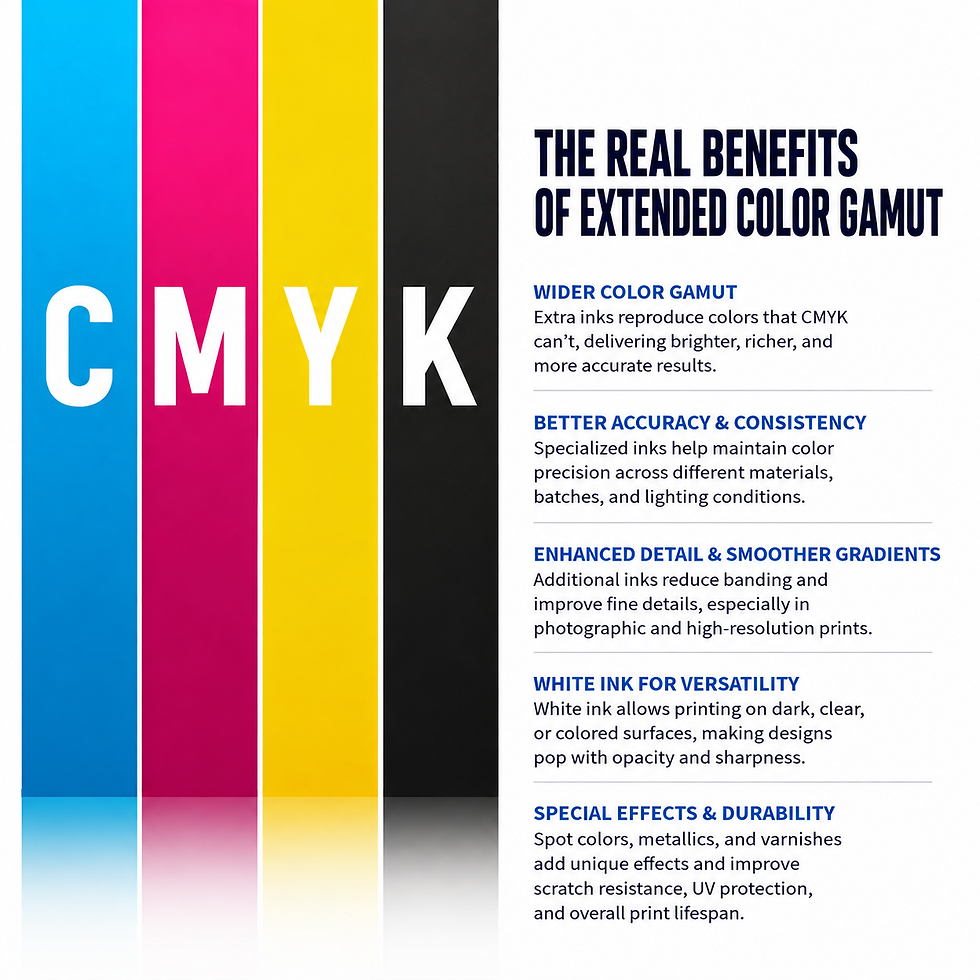
1. White ink is the single most important CMYK addition in transfer printing. Without it, you can't print on dark fabric, and dark garments make up a large share of apparel orders. Printers like the Mimaki TxF150-75 or the Mimaki UJV300DTF-75 run CMYK plus white, and UV DTF setups add a clear layer on top. That combination isn't optional, it's the difference between a shop that can take any order and one limited to light-colored substrates only.
For shops evaluating new equipment, Alpha Print Supply carries printers built around these extended ink sets specifically for this reason.
2. Vivid color accuracy also matters for brand work. Screen printing shops competing for corporate apparel contracts often lose bids over color matching, not price. A neon green or a specific Pantone orange in a logo needs to look identical on every reprint. Extended gamut inks reduce that variability and cut down on costly color correction and reprints.
The Trade-Offs You Need to Know
Extra ink colors aren't free, and they're not always worth it. Weigh these factors before upgrading:
Higher ink cost: Each additional channel is a separate cartridge or tank, meaning five to eight inks to manage instead of four.
Slower print speed: More color passes mean more time per print; some digital presses add close to a full second per additional separation.
More complex color management: You'll need updated RIP software and color profiles built for your specific ink set, or you won't see the gamut benefit at all.
Not every job needs it: Standard CMYK is still the right call for text-heavy documents, basic signage, and day-to-day runs where Pantone-exact matching isn't required.
The decision comes down to your customer base. If you print apparel, packaging, or branded materials where color accuracy drives repeat business, the investment tends to pay for itself. If you're producing general print work, standard CMYK remains the more cost-effective choice.
Bottom Line
Extended color gamut inks solve a genuine limitation in CMYK, the coverage gap shown in the table above is real and shows up in finished prints. But the right setup depends entirely on what you print and who you print it for.
If your shop needs the wider gamut, white ink for dark garments, OGV for brand-accurate packaging, or light inks for smooth photo gradients, Alpha Print Supply stocks high-quality printers and premium DTF/UV DTF consumables built to deliver on that.
Reach out today to talk through which ink configuration actually fits your print volume and customer demands, not just the specs on a sales sheet.
Frequently Asked Questions
Can CMYK really produce every color?
No. CMYK inks are limited by real-world impurities that prevent them from hitting the most saturated oranges, greens, and violets. Standard CMYK typically covers around 50–60% of Pantone colors within accepted tolerance, leaving a meaningful gap for brand-critical or vibrant work.
Do I need white ink if I only print on light-colored shirts?
Not necessarily. White ink is essential for dark or colored substrates, since CMYK inks are transparent and won't show up without a light background. If your orders are consistently light-colored garments, you can skip it for now.
Does adding extra ink colors slow down printing?
Yes, typically. Each additional ink channel adds a separate print pass, which increases total print time per piece. The exact slowdown depends on your printer model and how many extra colors you add.
Is extended gamut worth it for a small print shop?
It depends on your customer base. If you handle brand-sensitive work like corporate apparel or packaging, the color accuracy reduces reprints and complaints. For general-purpose printing, standard CMYK is usually more cost-effective.
What's the difference between OGV and white ink additions? OGV (orange, green, violet) expands the visible color gamut for more accurate hues. White ink is functional rather than gamut-expanding, it lets you print opaque colors on dark or transparent substrates where CMYK alone would be invisible.

Comments